

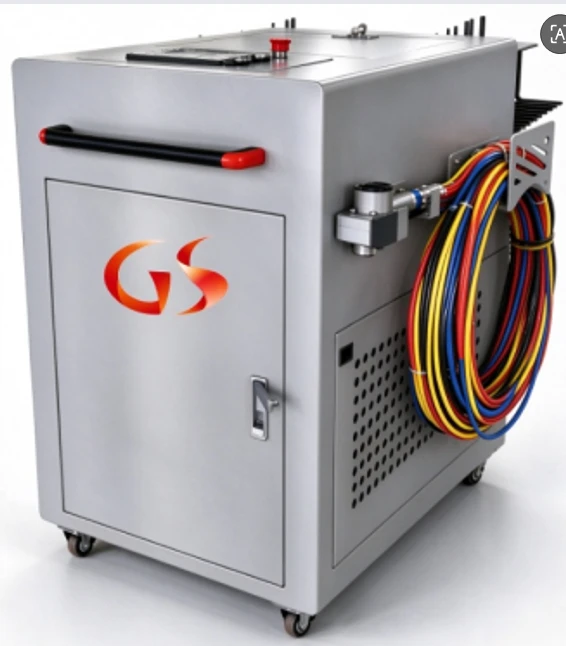
What is Laser Cleaning Machine
The laser cleaning machine is an eco-friendly cleaning device. It adopts nanosecond or picosecond pulsed lasers to irradiate the surface of the workpiece. The surface instantly absorbs the focused laser energy and generates rapidly expanding plasma (highly ionized unstable gas). This causes contaminants such as oil, rust, dust, coatings, oxide layers and films to vaporize or peel off, realizing efficient removal of surface attachments.
Benefits of Laser Cleaning Machine
Automated Assembly Line: The laser cleaning machine can be integrated with CNC machine tools or robots to implement remote control and cleaning, which can realize the automation of the equipment, and form a product assembly line operation and intelligent operation.
Accurate Positioning: Use optical fiber to transmit and guide the laser to make it flexible, and use the built-in scanning galvanometer to control the high-speed movement of the light spot, which is convenient for non-contacting of special-shaped parts, holes, grooves, and other parts that are difficult to reach by traditional cleaning methods. Ground laser cleaning treatment.
No Damage: Short-term impact will not heat the metal surface or cause no damage to the substrate.
Good Stability: The pulse laser used in the laser cleaning machine has a long service life, usually up to 100,000 hours, with stable quality and good reliability.
No Environmental Pollution: No chemical cleaning agent is needed and no cleaning waste liquid is generated. The pollutant particles and gas generated during the laser cleaning process can be collected and purified by the portable exhaust fan to avoid environmental pollution.
Low Maintenance Cost: There is no consumption of consumables during the use of the laser cleaning machine, and the operating cost is low. In the later stage, only the lens needs to be cleaned or replaced regularly. The maintenance cost is low, and it is close to maintenance-free.
Related Products

Main Advantages:
1.High cleaning efficiency:Suitable for large-area cleaning and continuous industrial operations.
2.High processing speed:Removes rust,paint,and oxide layers efficiently,especially
on larger metal surfaces.
3.Strong Cleaning capability:Suitable for relatively thick rust,heavy oxide layers,and
stubborn surface contaminants,depending
on the laser power and process parameters.
4.Cost-effective equipment:Generally offers a more economical equipment investment for high-throughput industrial cleaning.
5.Stable continuous operation:Suitable for production lines and repetitive industrial cleaning tasks.
6.Suitable for large workpieces:Ideal for steel plates,metal structures,pipes,and heavy indutrial components

1.Low heat Input:Minimizes thermal impact
on base materialsand reduces the risk of deformation.
2. High cleaning precision:Suitable for delicate
surfaces,precision components,and localized
cleaning.
3.Minimal Substrate damage:Helps protect the original materials while removing rust,paintand oxide layers.
4.Wide Material Compatibility:Suitable for stainless steel,carbon steel,aluminum,copper,
and other metal surfaces.
5.Ideal for pricision applications:Excellent for mold cleaning,electronic components,
aerospace parts,and restoration work.
6.Better Control of cleaning effects:Adjustable pulsed energy and frequency allow precise control over the cleaning process.
Quality Assurance
Guosheng Laser obtained the certification of ISO9001:2015, ISO14001:2015, ISO45001:2018.
Cutting-edge Technology
Guosheng Laser boasts solid technical resources, robust R&D capabilities and advanced manufacturing technologies. We offer short lead‑times and flexible technical services, delivering cost‑effective products and solutions to our customers.
Customer Service
Guosheng Laser provides 24‑hour technical support. Our highly‑skilled professional team is ready to resolve your inquiries and technical issues promptly..
5 Types of Laser Cleaning Machines
Handheld Laser Cleaners
Handheld laser cleanerHandheld laser cleaning systems are workstations on wheels. They're larger than what most people expect of a handheld device, but they're still easy to move around. The "gun" held by the operator can be positioned as needed to reach any area on large workpieces. These devices are ideal for low-volume productions where multiple parts of different shapes and sizes need to be processed.
Handheld laser cleaners come with laser configurations that can be manually selected for specific tasks, such as laser rust removal, paint removal, and corrosion removal. As with all types of laser cleaners, different configurations are needed for different contaminants, thicknesses, and substrates.
Laser safety is more complicated with handheld devices because the laser beam is not enclosed. Specific precautions need to be taken to ensure worker safety. Recommended laser safety features include a dual-action safety guard, a remote interlock, light warnings, laser safety eyewear, an isolated working area with warning signs, and training to ensure a safe usage. From a health and safety perspective, many companies forbid the use of class-4 handheld lasers in the workplace.
Manually Loaded Laser Cleaning Workstations
Laser cleaning workstations can be fully operated manually while being 100% safe for operators without PPE. Operators are responsible for loading parts into the machine and triggering the laser process. They may also need to perform other tasks depending on the type of workstation, such as opening the door, triggering table rotations, and managing fixtures.
Manual workstations can be equipped with a rotary table to meet high throughput requirements. They can be installed directly in the production line or offline.
Conveyor Laser Cleaning Machines
Conveyor Cleaning MachineLaser cleaners can be installed directly on conveyors to automate contaminant removal and surface texturing before operations like welding or coating, providing complete surface preparation in a single step. Advanced features can be used to automatically manage inconsistencies in part positioning as well as process large parts with several areas that need to be cleaned.
These machines are especially useful in the automotive industry where many parts are moved from one production step to another using conveyors, such as in battery production lines. Conveyor laser cleaning machines are adjusted to fit the conveyor dimensions.
Robot Laser Cleaning Machines
Laser cleaning systems can be mounted on robots to automate cleaning operations in robotic cells. They are equipped with advanced autofocusing systems to clean complex parts with high precision. The robot's high freedom of movement allows the laser to clean various shapes with simple, automatic adjustments.
Robot cleaning machines can also be used to automate the cleaning of large surfaces when mounted with an ultra-high-power laser.
OEM Laser Cleaning Systems
Fiber Laser MarkerThe difference between a laser cleaning system and a laser cleaning machine isn't always clear. Laser cleaning systems are OEM devices that can be integrated into fully custom solutions, typically with the help of a system integrator or machine builder. Laser cleaning machines, on the other hand, are predesigned solutions ready to be integrated in production lines.
Top 5 Most Popular Applications for Laser Cleaning Machines
Over time, metal surfaces can corrode, leading to rust that compromises the structural integrity of the material. Traditional rust removal methods involve harsh chemicals, which are bad for both the environment and your restoration crew. Laser cleaning, on the other hand, offers a more eco-friendly alternative to eradicating rust on machinery, one that leaves behind a corrosion-free surface.
You can also break out the laser cleaning machine to remove paint, coatings, and other surface treatments without the need for chemicals or physical abrasion.
For instance, you can prep an old machine for a fresh coat of paint through the use of concentrated light beams. Once the old paint has been removed, restorers can apply a fresh coat, bringing the components back to life. Businesses in the automotive and manufacturing sectors frequently use lasers for these purposes.
Before you weld or bond metal, you must ensure the surfaces are free of contaminants, or the joint could be compromised.
Laser cleaning offers a superior method for surface preparation, removing oils, oxides, and other contaminants with high precision. That's especially important in industries like aerospace and automotive manufacturing, where the integrity of welds and bonds is critical to safety and performance. By carefully cleaning the surfaces, welders ensure that they firmly bond together.
Manufacturers that produce goods using plastic injections or rubber molding frequently use laser cleaning machines to maintain and clean their molds. Traditional cleaning methods can be time-consuming and may cause wear and tear on the molds, shortening their lifespan and driving up manufacturing costs.
Lasers, in contrast, allow manufacturers to remove residues like plastic, rubber, or release agents without damaging the mold itself, thereby improving the overall efficiency of the manufacturing process and ensuring the lasting quality of produced parts.
From a cost perspective, businesses won't have to replace their production equipment as frequently, either, which leads to long-term savings.
The most robust laser-based machinery doesn't just clean surfaces. It can actually be used for cutting, too. The sheet metal industry often uses industrial laser cleaning machine lasers to cut materials and leave behind a clean edge. Lasers also allow workers to avoid harsh chemicals, which might impact the lifespan of sheet metal components.
Operating A Laser Cleaning Machine
Operating a laser cleaning machine is easy once you learn the instructions and follow them accordingly. We have included the basics of operating a laser cleaning machine here. But we suggest reading the manual thoroughly before operating the machine.

Initial Setup:
Read the manual and familiarize yourself with the machine's manual and safety instructions.
Set up the work area. Ensure the work area is clean and free of flammable materials.
Connect the machine to a power source and turn it on.
Adjust settings accurately and set the laser parameters according to the material and contaminant.
Cleaning Process:
Focus the laser and adjust the length to ensure the laser beam is precisely focused on the surface.
Perform a test run on a small, inconspicuous area to ensure optimal settings.
Proceed with cleaning. Move the laser head methodically over the surface, maintaining a consistent speed and distance.
Continuously monitor the cleaning process to avoid overheating or damaging the substrate.

How Does A Laser Cleaning Machine Work?
The laser generator generates a high-energy laser beam, and the optical system focuses the laser beam onto the surface of the object to form a very small cleaning spot. When the laser beam irradiates the surface of the object, dirt and impurities will absorb the laser energy, produce thermal expansion and thermal decomposition, and thus evaporate or peel off. The cleaning points move across the surface of the object, continuously removing dirt and impurities until the entire surface is cleaned. It can effectively and quickly remove attachments and excess coating from workpieces, and is considered the most effective solution for workpiece cleaning.
High Temperature Vaporization: The highly concentrated laser beam can generate very high heat energy around the spot, so dirt can be quickly vaporized or peeled off instantly;
Swell And Fall Off: The scattering of the laser beam is small and the direction is stable. We can adjust the energy density of the laser by controlling the laser beam spot with different diameters, so that the dirt is heated and then changed. When the expansion force of dirt is greater than the adsorption force of dirt to the substrate, detachment and falling will occur.
Shock Off: The laser cleaning beam can produce a high-frequency ultrasonic wave on the solid surface, thereby causing mechanical resonance to quickly break and fall off the dirt.
Materials of Metric Roller Chain Sprocket
Laser Cleaning Machine Parameters
Laser cleaning machine parameters are the different characteristics that reflect its performance. You need to understand each parameter to know which value will be suitable for you.
Power Level
Laser power is the amount of energy in the laser beam that is absorbed by the contaminants as heat. It is measured in Watts (W). For a continuous laser beam, the power of the Laser is the same as the power of the system. However, for a pulsed laser beam, the power of the system is the average power of pulses.
There are three distinct groups for the classification of laser power levels:
- Low Power Level
- Low power levels vary between the range of 20 Watts to 100 Watts. Choosing a low power laser if your application requirements include:
- Sensitive materials
- Valuable Artifacts
- Heirlooms
- Injection Molding Rubbers
Mid Power Level
Mid power levels vary between 100 Watts to 500 Watts. Mid power level laser cleaning machine is used for applications such as:
- Surface preparation for welding
- Corrosion removal
- Paint removal
- Aircraft Maintenance
High Power Level
High power levels vary between 500 Watts and go up to thousands of watts (rated in kilowatts). Some of the applications of high power laser cleaner are:
- Removing hazardous coating
- Removing firm corrosion from the metal surface
- Decontamination of nuclear material
- Paint removal
- Large mold release agents cleaning
- Surface smoothing varnish
- Grease cleaning
Wavelength
The laser cleaner's wavelength demonstrates the light's penetration depth into the contaminants. The correct wavelength depends on the type of contaminant being cleaned. Shorter wavelengths are preferable in laser cleaning due to better absorption by the contaminants. Wavelengths of Laser vary with the type of generation source used. Commonly encountered wavelengths are:
- UV Laser- 355 nm
- Nd: YAG Laser- 1064 nm
- CO2 Laser- 10600 nm
- Ti: Sapphire Laser- 650 nm to 1100 nm
- Fiber Laser- 1030 nm
Pulse Duration
The pulse duration is the time for which a single pulse is in contact with the surface. This is one of the important parameters for a pulsed laser. In the area of laser cleaning, the pulse duration is expressed in microseconds μs(10^−6 seconds), nanoseconds ns (10^-9 seconds), or picoseconds ps (10^-12 seconds). Typical pulse durations for various types of lasers are:
- Excimer Laser- 10 ns
- CO2 Laser- 100 ns
- Nd: YAG Laser- 10 ns
- Ti: Sapphire Laser- 10^-5 to 10^-3 ns
Spot Size
The spot size refers to the smallest possible diameter of a laser at the point of focus. In laser cleaning, the spot size is measured at the point of contact with the surface. A smaller spot size allows for a higher energy density in the laser beam. This provides a deeper and faster cleaning. However, narrowing down the spot size beyond a certain limit may be damaging to the underlying surface. Increasing the spot size too much will cause laser cleaning impossible and will initiate the laser welding process.
Scanning Speed
The scanning speed determines how fast laser pulses can move around the target object for surface cleaning. The scans at different locations are done through the internal optic mechanism of the laser system. The scanning speed also creates gaps or overlaps between the adjacent pulses. The overlap ratio might sometimes be required, depending on the product being cleaned. An important thing to note is that a higher overlap ratio tends to alter or damage the underlying surface.
Our Factory
Xi'an Guosheng Laser Technology Co., Ltd. is a high-tech enterprise specializing in R&D, manufacturing and sales of automatic laser cladding machine, high-speed laser cladding machine, laser hardening machine, laser welding machine, laser cleaning machine and laser 3D printer. Xi'an Guosheng Laser Technology Co., Ltd. was founded in 2015(Its wholly-owned subsidiary: Shaanxi Guosheng Laser Technology Co., LTD.). Guosheng Laser has established Xi'an Aerospace R&D and Design Center, Weinan Production Base and Xianyang Production Base. The company processes a workshop area of 2,000 m2, the quantity of employees is 30, including 5 senior research staff and engineers, which is capable of providing a complete set of solutions for laser additive manufacturing technology with integrated structure and function.


Our Certification
Guosheng Laser obtained the certification of ISO9001:2015, ISO14001:2015, ISO45001:2018.

Asked Questions
Hot Tags: 500W Pulsed-Wave Laser Cleaning Machine, China 500W Pulsed-Wave Laser Cleaning Machine manufacturers, suppliers, factory, laser cleaning testing, high speed laser cleaning, laser cleaning system integration, laser cleaning regulations, laser cleaning for prototype cleaning, factory floor laser cleaning


