


1. High-power laser source: high-power laser source that offers high-speed processing and high-quality beam output.
2. High precision: The device offers high precision and accuracy cutting,...
Laser Device
Your Professional Laser Device Manufacturer in China!
Guosheng Laser always attaches great importance to innovation and research and development. The engineers team covers the research and development, design, development, testing, analysis, pre-sales and after-sales services of laser cladding equipment and other projects. With huge technical resources, strong R&D strength, advanced production technology, fast delivery cycle, and flexible technical services, we provide customers with cost-effective products and considerate services.
Why Choose Us
High-Quality Service
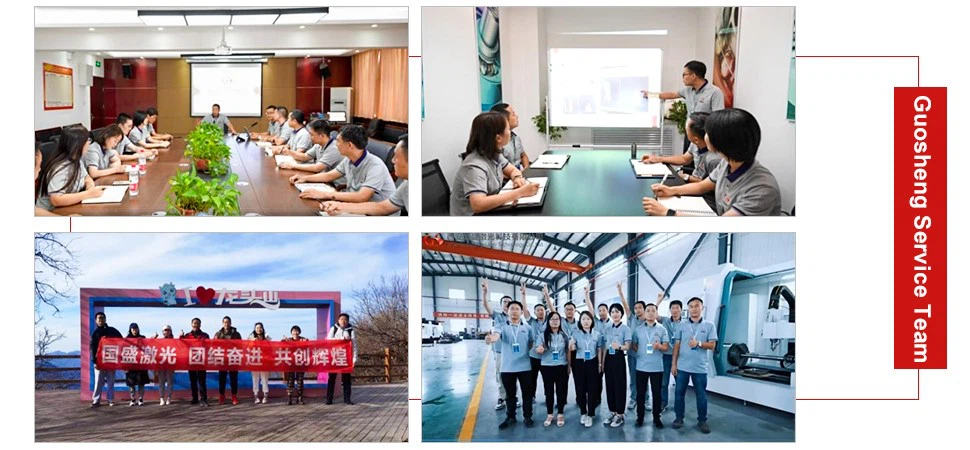
We have a professional service team. If you have any questions, you can contact our staff at any time and we will provide you with professional advice.
Certification
Guosheng Laser obtained the certification of ISO9001:2015, ISO14001:2015, ISO45001:2018.
Wide Range of Products
Xi'an Guosheng Laser Technology Co., Ltd. is a high-tech enterprise specializing in R&D, manufacturing and sales of automatic laser cladding machine, high-speed laser cladding machine, laser hardening machine, laser welding machine, laser cleaning machine and laser 3D printer.
Rich Experience
Our company has been engaged in this industry for more than 10 years and has been deeply involved in this industry. We have been committed to improving professional technology and equipment, continuously improving the service system, and providing better service to customers.
-
![Disk Laser]()
-
![Solid-state Laser]() Solid-state Laser1. Highly efficient, with typical conversion efficiencies of 30-50%read more
Solid-state Laser1. Highly efficient, with typical conversion efficiencies of 30-50%read more
2. Long lifetime, typically lasting tens of thousands of hours
3. Wide range of wavelengths, from UV to... -
![Blue Diode Laser]() Blue Diode Laser1. CW laser powers up to 3kW are achievable in the 450 nm wavelength rangeread more
Blue Diode Laser1. CW laser powers up to 3kW are achievable in the 450 nm wavelength rangeread more
2. Fast power regulation
3. Increase high anti-metal absorption rate
4. Practice-recognized system... -
![Dual Wavelength Laser]() Dual Wavelength Laser1. Two wavelengths of light for versatile useread more
Dual Wavelength Laser1. Two wavelengths of light for versatile useread more
2. High precision and accuracy
3. High beam quality and stability
4. Compact size and easy to use


Introduction of Laser Device
A laser device is a device that emits light through a process of optical amplification based on the stimulated emission of electromagnetic radiation. The word laser is an an acronym that originated as an acronym for light amplification by stimulated emission of radiation. A laser differs from other sources of light in that it emits light that is coherent. Spatial coherence allows a laser to be focused to a tight spot, enabling applications such as laser cutting and lithography. It also allows a laser beam to stay narrow over great distances (collimation), a feature used in applications such as laser pointers and lidar (light detection and ranging).
Benefits of Laser Device
More Accurate
The advanced laser beams of today can be focused down to a thousandth of a millimeter. This means that any measuring, marking, or cutting can be done with absolute precision. With computer chips and medical device components getting increasingly minuscule, laser technology offers superior accuracy and consistency that cannot be achieved with traditional machining equipment. Laser cuts are also incredibly clean, leaving no distortion or burrs on the remaining material. This negates the need for an additional step to clean or finish the product after laser processing.
Easy to Automate
With Industry 4.0 focusing on automation and the integration of technology with manufacturing, laser device can easily be added to production lines to achieve unprecedented standardization. Using lasers in manufacturing can lead to shorter cycle times, less maintenance, and more cost-effective production. Previously labor-intensive and error-prone operations can be done simply and flawlessly. When laser technology is combined with automation, processes can be completed at astonishing speeds. Lasers are currently the quickest method of cutting and welding on the production line.
Flexible Uses
Laser devices can work on a diverse range of materials including fabric, plastic, glass, and metal. Because laser parameters can be adjusted at any time, a single laser can perform numerous manufacturing tasks such as cleaning, etching, cutting, or welding. Unlike other comparable technologies, most laser devices are contactless, allowing them to be used on objects of various geometrical complexities while maintaining the integrity of their surfaces. Investing in a laser device has a high return on investment as it reduces redundancies and streamlines operations. The applications of lasers are increasing each day, providing more potential for the manufacturing floor.
Better for the Environment
Laser devices use a fraction of the energy of their conventional counterparts. More efficient energy consumption is essential for companies who want to lower production costs and reduce their emissions and carbon output. Lasers can also replace manufacturing methods that require consumables like welding fluxes, steel grits, or ink and labels. This prevents a considerable amount of waste and avoids the emissions associated with having to produce and transport these consumables as well. Finally, the laser device can be remarkably compact, allowing manufacturers to build more economical production lines and work within a smaller, more optimized factory footprint.
Application of Laser Device
Laser Marking
Laser devices are increasingly used to imprint unique identification (UID) numbers on parts and products, which allow them to be easily traced in the event of a recall. Laser markings are highly durable and, for medical devices, can withstand many cycles of sterilization. Both human-readable and barcode information, including lot and batch codes and even design histories, can be laser-marked on products with flat or curved part geometries.
Surface Texturing
Laser devices can create textures or patterned microstructures on the surfaces of components or products that improve physical performance, such as wear rates, grip, optical properties, and load capacity. Laser micro-texturing can create roughness on medical implants that make it easier for new tissue or bone to take hold and grow into the new implant, and patterns with features as small as 10 µm can be produced with very high depth resolution.
Laser Ablation
This subtractive machining method essentially vaporizes material with great precision using a laser beam. Pulse length, wavelength, and intensity are adjusted according to the material being processed. Ablation is especially useful for machining sensitive materials such as nanomaterials, or superconductive materials, because the non-contact method does not change the structure of the material or damage its surface with abrasion or heat.
Laser Drilling
Lasers are incredibly accurate at drilling micron-sized holes in a wide range of materials, including metals, polymers, and ceramics. Many of today's manufactured parts call for microscopic features that can only be created with laser drilling.
Laser Cutting
Similar to laser drilling, laser cutting relies on a focused laser beam to ablate material, straight cut, or cut patterns to very precise depths in the material or component. Ultrafast lasers are typically used for various types of metals and polymers because they cut clean edges and do not create heat-affected zones.
Laser Welding
This process is especially effective for products with complex geometries or dissimilar materials that are difficult to join together. Depending on the product, laser welding can be the best joining process compared to gluing or soldering, especially for connecting metals and plastics. It also creates strong, high-precision welds that can be as small as 0.004 inches and provide repeatable quality.
Wire Stripping
Wire stripping removes sections of insulation or shielding from wires and cables to provide electrical contact points and make the wire ready for termination. Laser wire stripping is a fast process that provides excellent precision and process control and eliminates contact with the wire, allowing for the processing of delicate wire gauges greater than 32 AWG. Insulation can be removed to within a 0.005-inch tolerance. Stripping can be programmed to ablate insulation at any point along the wire, enabling high-precision mid-span removals.
Common Laser Devices Component
Laser Generator
The laser generator is responsible for generating the laser beam; hence it is the core of how a laser marking machine works. It is the engine of any laser marking machine and the most expensive component on the list. Laser generators are majorly fiber or CO2 lasers.
Laser head
The laser head comprises the nozzle, focus lens, focus tracking system, etc. The laser head depends on the device, with some having a handheld movable laser head and being responsible for determining the marking speed and the fineness of the output laser line.


Software/Display
The marking software is the machine's brain, responsible for controlling the marking operation. Currently, there is much software for laser devices. For example, some laser devices have independently developed software while others use conventional software such as EzCAD. Each software has a display unit through which the machine is controlled. Ensure the display unit is devoid of liquids and cleaned with a dry, clean, and soft cloth.
Water Chiller
The water chiller is an important component of every laser device that functions in cooling the machine. Laser devices generate heat, and the chiller can quickly and efficiently cool the laser source, laser head, and other devices. Ensure the chiller you get has input and output control device switches, stable performance, and advanced functions for cooling water flow.
Types of Lasers
1
Fiber Lasers
Fiber lasers are a category of solid-state lasers that integrate an optical fiber as the lasing medium. They are known for high power, power efficiency, and remarkable beam quality. The lasing process takes place in the fiber medium, typically rare-earth-doped with erbium or ytterbium. Fiber lasers deliver high power and power efficiency, operating from low watts to high kilowatts. They create exceptionally efficient output energy from electrical power. This efficiency is achieved due to the distributed (i.e., not concentrated) gain medium (the fiber) and the resulting ability to lose heat. They create excellent beam quality, with narrow beam divergence and a near-perfect Gaussian beam profile. This allows precise focusing, suiting applications requiring high precision and small area energy application. They're compact and flexible in design. The fiber's flexibility allows for easy delivery of the radiation, suiting integrated applications and complex/flexible delivery paths.
2
Gas Lasers
Gas lasers use a gas mixture as the active lasing medium. The lasing is typically initiated by an electrical arc, which triggers stimulated emission. Variations within the class are significant in their different capabilities in wavelength and power, though their structures and operation are similar. Helium-neon (HeNe) lasers employ a mixture of helium and neon as the active medium. They produce (visible) red light at 632.8 nanometers (nm) and are suited to low-power, eye-visible applications. Carbon dioxide (CO2) lasers use a mixture of carbon dioxide, nitrogen, and helium as the active medium. They generate infrared (IR) light at a wavelength of 10.6 micrometers (μm). High power at low construction cost makes them widely used in industry for cutting, etc. Argon-ion lasers use ionized argon as the active medium. They emit visible light at various wavelengths. They are used in display systems and in research.
3
Excimer Lasers
Excimer lasers are an example of a subcategory morphed into a standalone classification. They are a type of gas laser, but their properties differ in key regards from general gas lasers, and they have characteristics that make them optimal for a number of applications. They can deliver ultraviolet (UV) emission at a relatively low cost, which is an unusual and useful feature. Some examples of excimer lasers are those available with 193 nm emissions (argon fluoride, ArF), 248 nm (krypton fluoride, KrF), and 308 nm (xenon chloride, XeCl).
4
Semiconductor Lasers (Diode Lasers)
Semiconductor lasers or diode lasers use a p-n junction arrangement as the active medium. They are compact in size, have high efficiency, and are versatile. Semiconductor lasers are structurally simple, as they are directly electrically pumped (i.e., not laser, arc, or flash-tube-initiated). Applying a forward bias current to the junction triggers the emission of laser light, as holes and electrons meet at the junction and are canceled out, with the emission of a coherent photon. Diode lasers are extremely compact, often measuring only a few millimeters, which allows for easy integration into devices and laser arrays. This is particularly useful for fiber-optic comms applications and for portable devices. They have high electrical efficiency, using only slightly more electrical power than they emit as laser radiation, making them suitable for battery-powered devices. Their class output across various types covers various wavelengths, defined by semiconductor dopants, bandgap, and amplifier structure: infrared, visible, and ultraviolet. This equips the class for most applications. These lasers are also used as efficient pump sources for other types of lasers, providing a compact alternative to xenon flash-tube pumping.
5
Dye Lasers
Dye lasers are a class that uses organic dye solutions as the active medium. They offer great tunability across the visible and near-infrared spectrum. Dye lasers can generate high-energy pulses of short duration. A typical xenon discharge tube exciting a dye laser will deliver intense bursts of light. This is ideal for time-resolved spectroscopy, photochemistry, and laser-induced breakdown spectroscopy. They are highly wavelength tunable across a broad spectral range, by changing the dye solution or adjusting the optical amplification cavity. This results in a wide range of wavelength radiation, from UV to NIR (near-infrared). Dye molecules result in a wide gain bandwidth, generating ultrashort pulses of femtosecond or picosecond durations. This makes them suited to research and medical applications, allowing very precise control of energy levels.
6
Chemical Lasers
Chemical lasers generate laser light from a chemical reaction excitation source. Violent exothermic chemical reactions between two or more initial chemicals produce a population inversion (of electrons in the excited state) resulting in stimulated emission for very high outputs. High output is possible, often in the megawatt range, from compact sources. This intensity makes chemical lasers valuable for military systems, laser-induced plasma, and high-energy physics. They can be operated in CW or pulsed mode. Pulse-mode chemical lasers are often used in military and defense applications, including directed-energy weapons and laser-based missile defense systems.
What Should be Considered When Choose Laser Device
Get To Know Your Target Audience
Understanding your client's desires and needs is an important first step before even looking at possible laser devices. Making sure that you have a clear picture of what your target audience is looking for and the corresponding treatment possibilities will spare you from investing in the wrong type of laser device that might not fully cater to your clients' needs.
Laser Specifications That Serve You The Most
Once you have figured out the most valuable treatment options to offer your clients, it is time to look at specific laser features. As there are a number of factors to consider, this can be overwhelming at first. However, there are a number of laser devices that have the versatility to maximise your treatment options. Another important step in your endeavour to find a suitable laser device must be to ensure a laser's compatibility with different skin types.
Quality of the device
As you search for a suitable laser for your clinic, it's essential to consider not only the type of laser you need but also your budget for the device. With a wide range of options available at varying price points, it's important to make an informed decision based on quality, efficacy, and your specific needs. When considering your options, keep in mind that the lowest quote may not always be the best choice. A higher price point could indicate superior efficacy, safety, and high-quality results, so it's crucial to weigh these factors carefully.
Warranty And Reliability of Service
As lasers are vastly complex devices, maintaining their proper functioning requires expertise and specialized equipment that only experienced laser technicians hold. This makes the level of service and support provided by the laser manufacturer just as crucial as the laser device itself. As your aesthetic laser undergoes regular use, there will come a time when repairs are necessary. To ensure the longevity and success of your investment, it's essential to choose a laser that comes with a comprehensive warranty.
How to Maintain Laser Device
Fill Tanks With Distilled or Deionized Water Only
Check the water levels in the cooling system daily to prevent overheating. The system cools the laser cavity and, sometimes, the power supply and hand pieces. Refill the water with your manufacturer's recommendation of distilled or deionized water. Do not overfill the tank, as leaks can damage the machine's electronics. Distilled and deionized water are both purified but undergo different purification processes. Distilled water is created by boiling water and collecting the condensed steam. Deionized water goes through an ion exchange process to remove nearly all ions.
Maintain the Cooling System
While you need to maintain the water daily, other parts of the cooling system need care less often. Follow your manufacturer's suggested maintenance timeline. Typically, water filters and water coolants require maintenance every six months. The entire cooling system needs disinfecting every 12 months.
Take Care of the Wires
Inspect external wires regularly for signs of wear or damage. Frayed or damaged wires can create safety risks and affect equipment performance. Cords can become damaged from catching on other surfaces, so untangle them to prevent damage. If you notice cable problems, contact a technician for repair or replacement.
Keep the Device at Room Temperature
Use and store your laser device in a temperature-controlled room. Extreme temperature fluctuations can lead to equipment malfunction or reduced efficacy; they may also cause elements in the machine to expand and contract. Overheating errors can occur if the room temperature exceeds 75–80 degrees Fahrenheit during use. Even when not in use, overly hot or cold ambient temperatures can damage the machine.
Dust Routinely
Accumulated dust can compromise the performance and longevity of your laser equipment. Dusting routinely prevents debris from entering the machine and causing internal damage, which can lead to problems such as a cracked optical lens. Follow this routine dusting checklist every time.
Don't Point the Laser at the Machine
Avoid pointing the laser beam at the machine, especially during calibration or maintenance. Directing the laser at the machinery can cause unintended reflections or damage sensitive components. Always exercise caution and direct the laser away from the equipment and toward the appropriate targets.
Protect the Cords
Protect the machine's cords by avoiding bending or kinking them excessively. Avoid walking on or rolling over cables along the floor, such as the one connecting a foot pedal to the rest of the machine. Be mindful of foot traffic or moving equipment to prevent tripping or accidental yanking. Inspect cords for signs of damage, and replace them when you notice cuts, cracks, or exposed wires. Cords can trap dust and debris. When cleaning cables, do not immerse them in liquid. Instead, use a clean, soft, lint-free rag and a mild cleaner to remove dirt.
Schedule Equipment Inspections
Scheduled inspections and preventative maintenance by a qualified technician can ensure the performance of your machine. Technicians can identify and address potential issues or signs of wear and tear that may affect the equipment's functionality. Scheduled maintenance visits can also assure safety. A service technician will assess the integrity of components, check electrical connections, and ensure all safety features function correctly. Catching potential problems early on can give you peace of mind and help you save substantial money and machine downtime. Many laser manufacturers recommend professional service every six months.
Our Factory
Xi'an Guosheng Laser Technology Co., Ltd. was founded in 2015. The company processes a workshop area of 2,000 m2, the quantity of employees is 30, including 5 senior research staff and engineers, which is capable of providing a complete set of solutions for laser additive manufacturing technology with integrated structure and function.



Our Certification
We have passed many international certifications, such as ISO9001:2015, ISO14001:2015, ISO45001:2018.


Ultimate FAQ Guide to Laser Device
Q: What precautions should you take when using a laser device?
A: Totally enclosing the laser in an interlocked cabinet to prevent exposure to the beam. No windows or windows covered to avoid laser exposure outside the controlled area. Use of shutters, attenuating filters to prevent access to the laser beam from the aperture.
Q: What can a laser not go through?
A: Lasers cannot be stopped by other light, but they can be stopped with matter. So if you shine a laser pen on the wall, the laser will not go through the wall because the matter has stopped it and scattered it.
Q: What is an important rule when dealing with laser devices?
A: Never allow a laser beam to escape its designated area of use. Position the laser device so that the beam is well above or below eye level. Always block beams with a diffuse reflecting beam block that is sufficient to handle the power of the beam. Remove all unnecessary reflective objects from the area near the beam's path.
Q: What can make a laser device inaccurate?
A: Laser devices depend on the reflection of an internally generated laser beam to measure the distance between two points. In a very few instances, the distant surface will "absorb" or "refract" rather than reflect the laser beam, resulting in inaccurate measurements.
Q: What is the principle of disk laser?
A: The gain medium is a thin crystalline disk, bounded on a heat sink. The rear side of the disk is HR coated for the laser wavelength as well as for the pump wavelength. The disk itself acts as an HR mirror of the laser resonator, as well as a bending mirror for the pump beam.
Q: What is the wavelength of disk laser?
A: The pump source of a thin-disk laser is usually based on high-power diode bars, either in fiber-coupled form or with free-space power delivery. A typical pump wavelength is 940 nm for Yb:YAG, whereas ytterbium-doped tungstate crystals can be more efficiently pumped near 981 nm.
Q: How long do fiber lasers last?
A: A fiber laser has a higher life expectancy than other laser solutions. The diode module found in a fiber laser functions three times longer than other laser technologies. The pumps in fiber laser have proven expected lifetime of greater than 100,000 hours.
Q: How efficient are fiber lasers?
A: Simply put, fiber lasers win by far on energy efficiency with a 30-50% power conversion rate vs. the 10-15% achieved by CO2 lasers.
Q: What is the maintenance of fiber laser?
A: To ensure the longevity and optimal performance of your fibre laser cutting machine, a few simple measures must be taken. Perform daily cleaning of the lens, nozzles, and work area to prevent debris buildup. Regularly lubricate the moving parts to reduce friction and ensure smooth operation.
Q: How accurate is fibre laser?
A: Fiber laser cutters are known for their exceptional precision, often achieving tolerances as tight as ±0.003 inches. The focused beam spot size can be extremely small, allowing for intricate cuts and detailed work.
As one of the most professional laser device manufacturers and suppliers in China, we're featured by quality products and competitive price. If you're going to buy hot sell laser device for sale, welcome to get quotation from our factory. Also, customized service is available.
laser coupler device, laser milling device, laser emission device