

Laser welding has become an indispensable process in modern manufacturing, valued for its high precision, minimal heat impact, clean welds, and wide compatibility with various materials. For manufacturers, engineering teams, and procurement decision-makers, selecting the right Laser Welding equipment and mastering process optimization directly determine production stability, product quality, and cost efficiency. This guide covers core processes, key parameters, equipment selection, and defect troubleshooting to help you achieve reliable and high-performance laser welding.
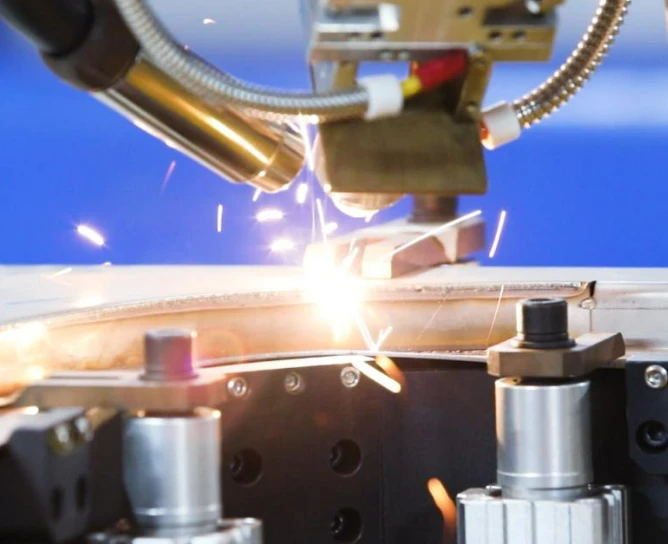
Main Types of Laser Welding Processes: Conduction, Keyhole and Remote Welding
Conduction Welding occurs when laser energy is absorbed by the material surface and transferred inward through heat conduction. It features a shallow weld depth, low heat input, and small deformation, making it ideal for thin sheets, small parts, and precision components such as electronic connectors and thin metal shells.
Keyhole Welding, also known as deep penetration welding, uses high-intensity laser to instantly vaporize metal and form a stable "keyhole" inside the material. This mode provides deep and narrow welds, high efficiency, and strong fusion, widely used in thick plates, structural parts, and high-strength connections in automobiles, hardware, and new energy products.
Remote Welding uses a galvanometer scanning system to achieve high-speed, non-contact welding without mechanical movement in a large working area. It supports rapid pattern switching and is suitable for batch assembly lines with multiple welding points, such as automotive parts and home appliance shells.
Understanding these three processes helps you match the correct equipment structure and power configuration for actual production needs.
Key Parameters to Adjust for Stable and Defect-Free Laser Welding
Laser power directly affects penetration depth and fusion speed. Insufficient power leads to incomplete fusion, while excessive power causes spatter, burn-through, or excessive thermal deformation.
Welding speed influences heat input and molding. Higher speed improves efficiency but may reduce penetration; lower speed increases heat accumulation and may cause material deformation or coarse grain structure.
Focal position is critical for precision. The laser focus spot offers the highest energy density. Deviations from the optimal focal position will reduce welding stability, resulting in shallow welds or inconsistent forming.
Shielding gas type and flow rate protect the molten pool from oxidation and remove plasma. Appropriate shielding improves weld smoothness, reduces porosity, and enhances surface quality.
By fine-tuning these parameters, manufacturers can significantly reduce defects and achieve stable, repeatable welding results.

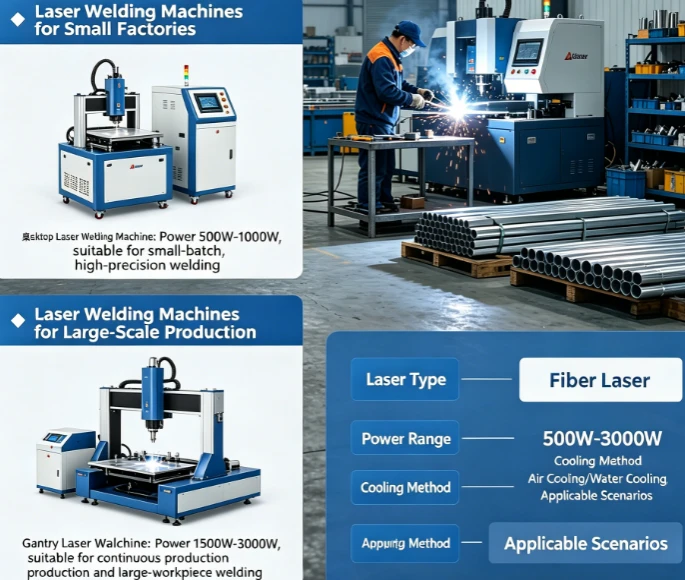
Laser Welding Machine Buying Guide: Factors for Small Factories and Mass Production
For small factories, workshops, and customized production, priority should go to flexible, easy-to-operate, and cost-effective models such as handheld laser welders or small desktop fiber laser welding machines. These feature compact size, simple setup, low maintenance, and support multiple material types.
For automated and mass production lines, integrated fiber Laser Welding systems with automatic fixtures, robotic arms, or galvanometer scanning are more suitable. They provide higher power, faster speed, continuous work capability, and stable output under long-term operation.
Other important factors include material type and thickness, welding appearance requirements, after-sales support, and brand reliability. A well-matched machine improves production efficiency while lowering long-term operating costs.
Common Laser Welding Defects, Causes and Effective Troubleshooting Tips
Porosity is usually caused by unclean surfaces, insufficient shielding gas, or unstable keyhole. Solutions include cleaning materials, optimizing gas flow, and adjusting power and speed.
Cracks often result from excessive internal stress or material incompatibility. Measures include preheating, improving joint design, and selecting matching welding parameters.
Spatter is commonly caused by high power, inappropriate focus, or excessive surface pollutants. Solutions involve optimizing focal position, reducing heat input, and keeping materials clean.
Deformation comes from excessive heat input. Solutions include reducing laser power, increasing welding speed, using thermal symmetry strategies, and adding proper fixtures.
By identifying defects and taking targeted corrective actions, manufacturers can greatly improve yield and product reliability.
Conclusion
Choosing the right laser welding machine and optimizing the welding process are key to achieving high-quality, efficient, and stable production. By understanding different welding processes, controlling key parameters, selecting equipment based on production scale, and troubleshooting common defects, enterprises can fully leverage the advantages of laser welding to enhance competitiveness, improve product quality, and support long-term industrial development.
