

Laser Cladding Technology: An Efficient Solution for Repairing Large Industrial Components
In industrial production and equipment maintenance, large components (such as ship propellers, bridge support columns, and aero-engine parts) are prone to corrosion, wear, cracks, and other issues due to harsh service environments. Traditional repair technologies often face challenges like low precision, numerous defects, and high costs. Endowed with the characteristics of high energy density and precise control, laser cladding technology has become a key solution to address these problems-it not only enables efficient component repair but also extends their service life. This article will explore the technical principles, multi-industry applications, core advantages, and development prospects of laser cladding technology, illustrating how it provides reliable support for the industrial sector.

Laser Cladding Technology: Core Principles from Energy Action to Forming
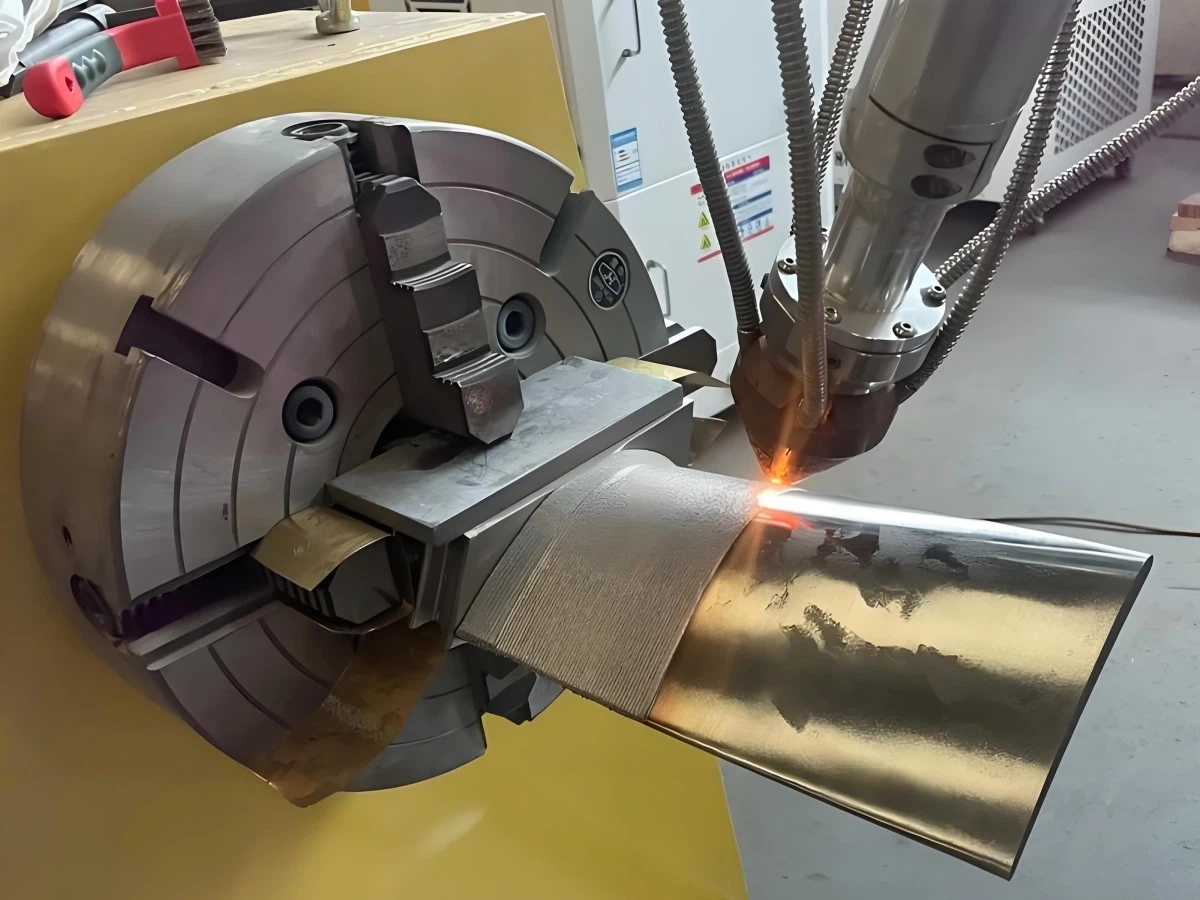
The core of laser cladding technology lies in completing the process of "material melting - metallurgical bonding - precise forming" through a high-energy-density laser beam. Firstly, a numerical control system controls the laser beam (with an energy density typically reaching 10⁴-10⁶ W/cm²) to directionally heat the metal or alloy powder preset on the surface of the base material. Secondly, the powder rapidly heats up to above its melting point and fully melts; at the same time, a thin layer on the surface of the base material also melts partially, forming a metallurgical bonding interface consisting of "cladding layer - transition layer - base material," which avoids the physical adhesion defects of traditional repair methods. Subsequently, after the laser beam moves, the molten pool cools rapidly (with a cooling rate of 10³-10⁶ K/s) through heat conduction of the base material, solidifying into a dense coating. Finally, by adjusting parameters such as laser power and scanning speed, the thickness of the cladding layer (ranging from several micrometers to several millimeters) can be precisely controlled to meet different repair requirements.
Laser Cladding Technology: A Repair Tool for the Shipbuilding and Bridge Industries
Ships and bridges, as large-scale infrastructure, are affected by harsh environments for a long time, resulting in urgent repair needs. In the shipbuilding industry, laser cladding technology can repair propellers (blade wear, cavitation corrosion) and rudders (edge impact damage). It avoids deformation caused by traditional welding, eliminates pores and cracks, and the cladding layer has better seawater corrosion resistance than the base material, extending the service life of components by 30%-50%. In the bridge industry, it can repair bridge deck steel boxes (wear from vehicle rolling) and support columns (weld fatigue cracks) on-site without large-scale disassembly. The bonding strength between the cladding layer and the base material reaches over 80% of that of the base material, ensuring the load-bearing safety of bridges and reducing maintenance costs.
Laser Cladding Technology: A Precision Repair Solution for the Aviation and Heavy Machinery Industries
The aviation and heavy machinery sectors have extremely high requirements for component precision and reliability, and laser cladding technology demonstrates significant advantages here. In the aviation industry, it can repair aircraft fuselage skins (wear from air flow scouring) and aero-engine turbine blades (high-temperature oxidation cracks). When high-temperature alloy powder is used, the dimensional error of the cladding layer is ≤ ±0.1mm, and there is no welding stress concentration, avoiding flight risks. In the heavy machinery industry, for castings such as gears (tooth surface wear) and bearing housings (inner hole out-of-tolerance), laser cladding can accurately restore the original dimensions while increasing the surface hardness to HRC 50-60, allowing damaged castings to be put back into service and saving 50%-70% of spare part costs.
Four Core Advantages of Laser Cladding Technology: Efficiency, Precision, Applicability, and Stability
Compared with traditional repair technologies, the advantages of laser cladding technology are concentrated in four aspects. In terms of efficiency, the laser heating is concentrated with a small heat-affected zone (0.1-1mm), and the repair speed reaches 0.5-2m/min, reducing the downtime of large components. In terms of precision, the dimensional error of the cladding layer is ≤ ±0.1mm, and the surface roughness reaches Ra 3.2-6.3μm, which can meet tolerance requirements without secondary processing. In terms of wide applicability, it is compatible with various base materials such as steel, aluminum, and titanium alloys, and can be customized with wear-resistant and corrosion-resistant powders to meet the needs of multiple industries. In terms of stability, the cladding layer forms a metallurgical bond with the base material, eliminating the risk of delamination and avoiding defects such as pores and inclusions in traditional welding, ensuring the long-term service safety of components.
Summary of the Development Prospects and Industrial Value of Laser Cladding Technology
Laser cladding technology is not only a means of component repair but also a key support for promoting "green manufacturing" and "full-life-cycle management" in the industry-it reduces resource waste caused by component scrapping and lowers the maintenance costs of enterprises. With the development of high-power fiber lasers and robotic automation technology, laser cladding is moving towards "intelligence and integration." In the future, it will make breakthroughs in high-end fields such as nuclear power equipment and deep-sea equipment. In conclusion, relying on its core advantages of efficiency and precision, laser cladding technology will continue to provide reliable repair support for industries such as shipbuilding, aviation, and heavy machinery, and become an important part of the industrial intelligent manufacturing system.