

Must High-Power Lasers Be Equipped with Laser Water Chillers?
In fields such as industrial cutting, precision welding, and scientific research, high-power lasers have become core equipment due to their ultra-strong energy density and precise operation capabilities. However, high-power output is often accompanied by the generation of a large amount of heat, which raises a common concern in the industry: Must high-power lasers be equipped with laser water chillers? In fact, heat management directly determines the performance stability and service life of lasers. As professional heat dissipation equipment, the supporting relationship between laser water chillers and high-power lasers has become an industry consensus. This article will deeply analyze the inevitable connection between the two from the dimensions of heat generation characteristics, performance impact, and practical needs.

Heat Generation Characteristics of High-Power Lasers: Urgent Need for Heat Management
The energy conversion of high-power lasers (usually referring to fiber lasers, CO₂ lasers, etc., with power ≥ 500W) is not 100% efficient. Part of the electrical energy is converted into heat, which concentrates on core components such as laser resonators, pump sources, and optical lenses. Taking the common 3000W fiber laser as an example, it can generate thousands of joules of heat per hour during operation. If only relying on natural heat dissipation or simple air cooling, heat will accumulate rapidly. This heat is not only "useless work" but also forms a local high-temperature environment, leading to changes in the physical properties of components. Therefore, aiming at the heat generation characteristics of high-power lasers, establishing an efficient heat dissipation system is the basic prerequisite for ensuring the normal operation of the equipment, and the laser water chiller is the core equipment to achieve this goal.
Hidden Dangers Without Water Chillers: Direct Impact on Core Performance of Lasers
If high-power lasers are not equipped with laser water chillers, the accumulated heat will trigger a series of chain problems. The first is the "thermal drift" phenomenon. High temperature will cause deformation of the laser resonator and degradation of beam quality, reducing the cutting accuracy from the 0.01mm level to the 0.1mm level, which cannot meet the needs of precision processing. Secondly, the pump source will experience efficiency attenuation at high temperatures, and the output power of the laser may drop by 10%-30% with increased fluctuation range. More seriously, long-term high temperature will accelerate the aging of optical lenses and the peeling of coatings, shortening the service life of core components by more than 50%. Frequent replacement of components will significantly increase operation and maintenance costs. In addition, overheating may trigger the equipment protection mechanism, leading to frequent shutdowns and affecting production continuity.


Core Value of Laser Water Chillers: Precise Temperature Control Ensures Stable Operation
Laser water chillers are specially designed for the heat dissipation needs of high-power lasers, and their core advantages lie in "precise temperature control + efficient heat dissipation". Through the coordinated work of components such as compressors, evaporators, and condensers, the water chiller uses water or special coolant as the medium to circulate in the heat dissipation channel of the laser, stably controlling the temperature of core components within the optimal range of 20-25℃, with a temperature control accuracy of up to ±0.1℃. This stable temperature environment can effectively suppress thermal drift and ensure the stability of laser output power and beam quality. At the same time, the efficient heat dissipation capacity of the water chiller can quickly remove excess heat and avoid component damage caused by high temperature. For example, a 5000W CO₂ laser equipped with a professional water chiller has a core component temperature fluctuation of no more than 0.5℃ after 8 hours of continuous operation, which significantly ensures the operation accuracy and equipment service life.
Industry Application Verification: Equipped Water Chillers Are a Necessity Rather Than a Choice
From the perspective of practical application scenarios, equipping high-power lasers with laser water chillers has become an industry standard. In the laser welding production line of auto parts, if fiber lasers above 2000W are not equipped with water chillers, the welded joints are prone to defects such as pores and cracks, with a qualification rate of less than 60%; while the qualification rate can be increased to more than 99% after equipping with water chillers. In the field of scientific research, when high-power pulsed lasers conduct material modification experiments, temperature fluctuations will lead to deviations in experimental data. Only by means of water chillers to achieve constant temperature control can the accuracy and repeatability of the data be ensured. In addition, mainstream laser manufacturers clearly require in the equipment manual that high-power models must be equipped with special laser water chillers, otherwise no quality assurance service will be provided, which also confirms its necessity from the side.

Laser equipment components

Fiber Laser Machine

Laser Cladding Head
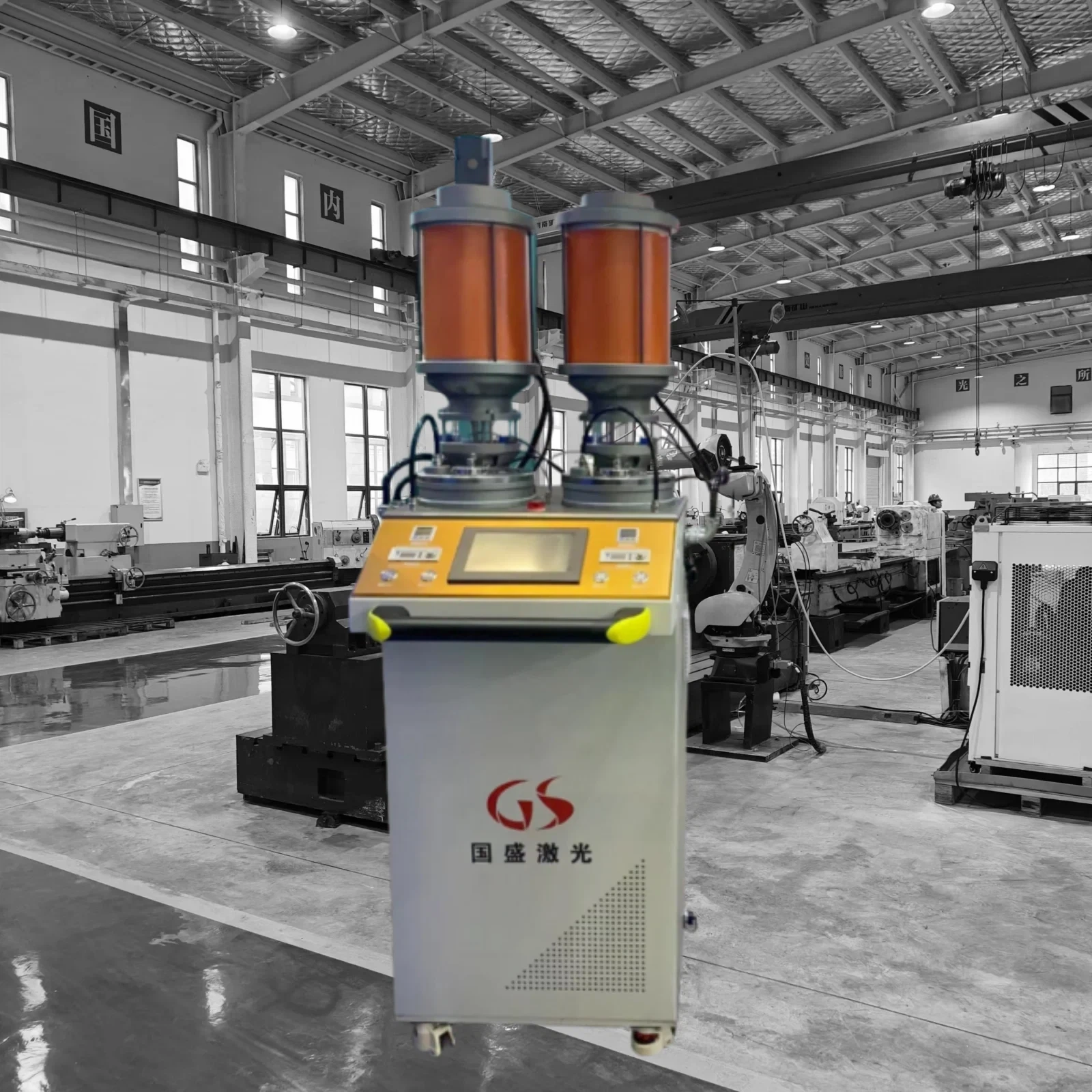
Powder Feeder

Laser Hardening Head
The "Standard Escort" for High-Power Lasers
Comprehensively considering the heat generation characteristics of high-power lasers, the serious hidden dangers without water chillers, the core value of water chillers, and industry application practices, it can be concluded that laser water chillers are not "optional accessories" for high-power lasers, but "standard escorts" that ensure their stable, efficient, and long-life operation. For enterprises and scientific research institutions, when selecting high-power lasers, they need to match suitable laser water chillers simultaneously. This is not only an effective protection for the equipment but also a key measure to improve production efficiency, ensure operation quality, and control comprehensive costs. With the development of laser technology towards higher power, the precise temperature control and energy-saving performance of laser water chillers will be further upgraded, continuously empowering high-power laser applications.