

Combining Laser Cladding and Nitriding
Laser Cladding technology is a cutting-edge surface modification method, utilizing precise laser melting of alloy powders to form a high-performance coating on the substrate, aimed at significantly boosting the wear and corrosion resistance of heavy-duty components. This article focuses on the laser clad layer of the high-performance nickel-based alloy system-the (NiCr)$_{92-x}$Mo$_8$Ti$_x$-and the composite effect of subsequent Nitriding Treatment on its microstructure and mechanical properties. Nitriding, a classical thermochemical process, involves high-temperature nitrogen diffusion to generate ultra-hard phases in situ on the coating surface. This "cladding-nitriding" synergistic strengthening strategy aims to achieve a step-change increase in coating performance. We will thoroughly analyze how this combined treatment reconstructs the structure to offer a reliable, high-value surface strengthening solution for critical components operating under extreme wear conditions, thereby extending their service life significantly and pioneering new directions for high-performance material design.

Nitride Phase Formation and Microstructural Reconstruction
The effect of the nitriding process on the microstructure of the (NiCr)$_{92-x}$Mo$_8$Ti$_x$ coating is fundamental and definitive. In a high-temperature nitrogen atmosphere, the highly active elements within the coating, especially Titanium (Ti) and Chromium (Cr), preferentially react with the inward-diffusing nitrogen atoms. This process leads to the rapid precipitation and uniform distribution of high-hardness, high-stability nitride phases, primarily $TiN$ and $CrN$. Due to its exceptionally high hardness and thermal stability, $TiN$ is identified as the primary contributor to the coating's hardness boost. These newly formed nitride particles are dispersed uniformly within the nickel-based $(\gamma-Ni)$ solid solution matrix, effectively acting as pinning points for dislocation motion. This mechanism achieves excellent Orowan strengthening of the substrate. Furthermore, some nitrogen atoms interstitially dissolve into the lattice, providing a noticeable solid solution strengthening effect. Crucially, the presence of these nitride particles inhibits grain coarsening during the heat treatment process, resulting in a finer and more uniform microstructure. This microstructural reconstruction is the essential prerequisite for the subsequent dramatic improvement in mechanical strength and stability.
Hardness Enhancement: A Quantum Leap and Composite Strengthening
The improvement in the hardness of the (NiCr)$_{92-x}$Mo$_8$Ti$_x$ coating post-nitriding is revolutionary, serving as the direct basis for its enhanced wear resistance. The surface microhardness of the treated coating typically increases severalfold compared to the as-clad state, enabling it to effectively resist indentation and plastic deformation under high loads. This dramatic increase in hardness stems from the synergistic effect of three composite strengthening mechanisms: First, Dispersion Strengthening, provided by the high volume fraction and ultra-fine size of hard $TiN$ and $CrN$ nitride particles; second, Solid Solution Strengthening, where nitrogen atoms induce lattice strain in the matrix, raising the stress required for dislocation slip; and third, Grain Boundary Strengthening, where the fine and uniform grain structure helps inhibit crack initiation and propagation. Notably, the Titanium content (the $x$ value) in the coating directly determines the potential amount of $TiN$ that can form, making it a critical design parameter for controlling the final hardness. By precisely managing the $x$ value and optimizing the nitriding process, engineers can tailor the surface hardness to meet the stringent high-load and wear resistance requirements of specific industrial applications.


Superior Wear Resistance and Wear Mechanism Transition
The significant increase in hardness is the key factor driving the enhanced wear resistance of the laser-clad layer after nitriding. The high-hardness nitride layer effectively resists abrasive cutting and plastic grooving caused by counterpart materials, drastically reducing wear volume. Concurrently, the dense, stable nitride surface structure acts as a physical barrier during frictional contact, lowering the friction coefficient and effectively suppressing the phenomenon of adhesive wear. For components operating at high temperatures or experiencing significant frictional heat, the $TiN$ and $CrN$ phases exhibit excellent thermal stability and oxidation resistance, preventing oxygen ingress and mitigating oxidative wear. This composite treatment induces a fundamental transition in the wear mechanism: shifting from the primarily abrasive and plastic wear modes seen in the as-clad state to one dominated by micro-brittle fracture or the stable detachment of nitride particles post-nitriding. This change significantly lowers the material loss rate, ensuring the coating's long-term stable service capability under severe operating conditions.
Design and Optimization of Ti Content in Composite Strengthening
In the (NiCr)$_{92-x}$Mo$_8$Ti$_x$ coating system, the Titanium content (the $x$ value) plays a decisive role in determining both the nitriding effect and the final performance. As one of the most effective nitride-forming elements, the Ti content directly dictates the potential quantity of ultra-hard $TiN$ phases that can be formed. Therefore, a higher $x$ value theoretically enables the formation of more dispersed $TiN$ hard particles, resulting in superior surface hardness and wear resistance. However, the selection of Ti content must adhere to a balance principle: while increasing Ti promotes nitriding, excessively high Ti content can significantly increase the hot cracking susceptibility during the laser cladding process, compromising the metallurgical bond and overall integrity of the clad layer. Furthermore, the $x$ value also influences the coating's melting point and original phase composition. Material scientists must therefore use precise experimental design and process optimization to identify an optimal range for the $x$ value, achieving a perfect balance between "stable cladding quality" and "maximized nitriding strengthening effect." This composition-based composite strengthening approach is vital for developing next-generation, high-performance surface engineering materials.

Laser equipment components

Fiber Laser Machine

Laser Cladding Head
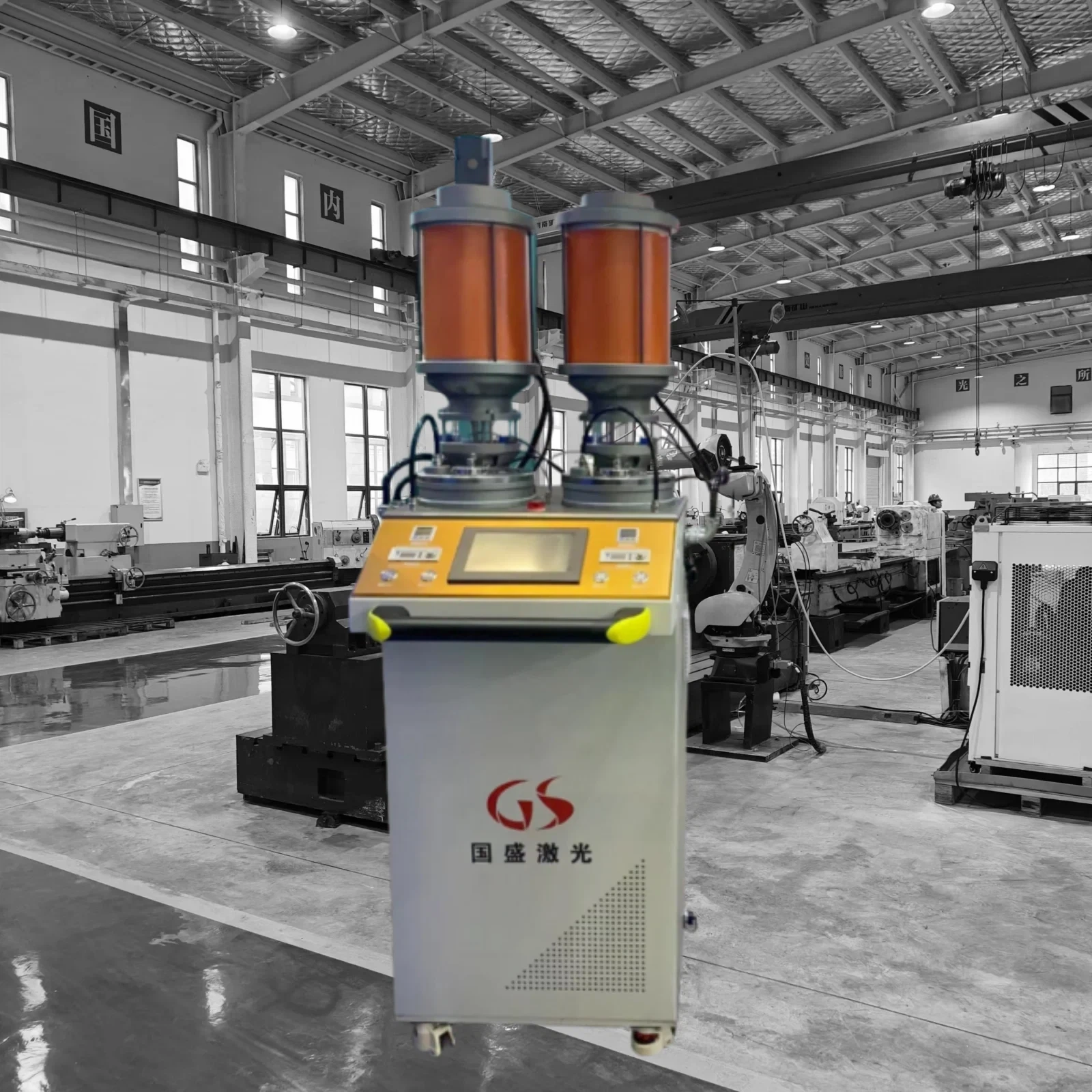
Powder Feeder

Laser Hardening Head
Nitriding Imparts Lasting Toughness
The nitriding treatment provides a highly effective and transformative means of strengthening the laser-clad (NiCr)$_{92-x}$Mo$_8$Ti$_x$ coating. Through high-temperature nitrogen diffusion and in situ reactions, this composite surface modification technique successfully constructs a gradient functional layer reinforced by the massive, dispersed precipitation of ultra-hard $TiN$ and $CrN$ nitrides. This microstructural reconstruction is the root cause of the severalfold increase in microhardness and, consequently, the significant improvement in wear resistance. Nitriding not only enhances the coating's resistance to various wear types (abrasive, adhesive, and oxidative) but also optimizes its wear mechanism, imparting lasting toughness and durability to the clad layer. In practical engineering applications, precise control over the critical element Ti content and meticulous optimization of nitriding parameters are the core technologies for achieving high-performance surface enhancement. This "cladding-nitriding" composite strengthening strategy offers an ideal surface engineering solution for critical components in high-end manufacturing, showcasing broad potential for industrialization.