

Laser Cladding Process: An Efficient Repair Technology for Solving Part Surface Failure
As industrial equipment advances toward high precision and high load capacity, surface failure issues of core components such as rotor blades, gears, and roller shafts-caused by wear, corrosion, and fatigue-have become increasingly prominent, directly leading to equipment downtime and high replacement costs. According to industry data, parts with only surface damage account for over 60% of total scrapped parts, and efficient repair technologies can save 50%-70% of costs. Among numerous repair solutions, the Laser Cladding Process stands out as a core technology for addressing part surface failure due to its advantages of low damage, high precision, and high performance. It not only extends part service life but also aligns with the needs of industrial sustainable development.

Pain Points of Part Surface Failure and Repair Value of Laser Cladding
Surface failure of industrial parts mostly stems from complex working conditions (e.g., high temperature, high pressure, high wear). Common failure types include erosive wear of rotor blades, tooth surface spalling of gears, and surface corrosion of roller shafts. Discarding parts solely due to surface damage not only wastes metal resources but also increases equipment maintenance cycles and costs. However, the Laser Cladding Process, with its "localized precision repair" feature, can custom-clad functional layers (resistant to wear, corrosion, or high temperature) when the base material performance of parts meets standards. This not only avoids the high costs of full replacement but also reduces raw material extraction and carbon emissions, perfectly matching the industrial needs of "cost reduction, efficiency improvement, and resource recycling."
Technical Principle and Core Advantages of Laser Cladding Process
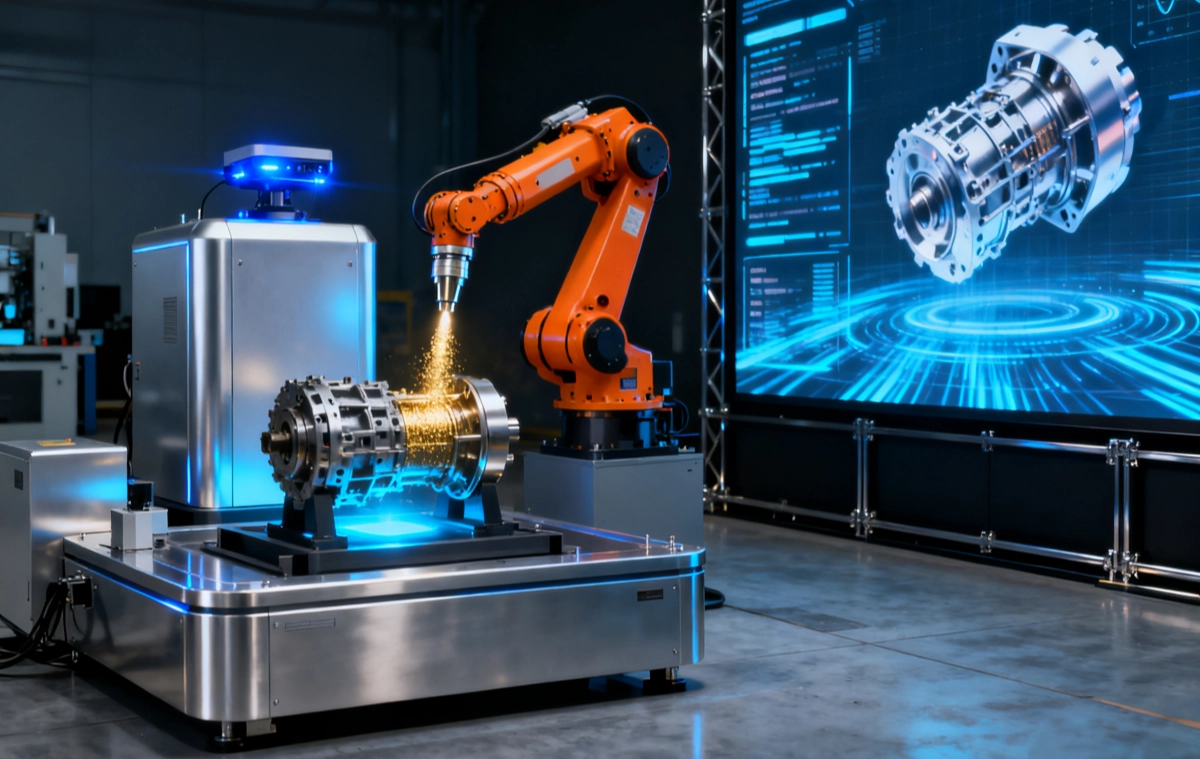
The core of the Laser Cladding Process lies in "customized rapid cooling repair": based on the part's working conditions, metal powders (e.g., nickel-based alloys, cobalt-based alloys) or ceramic-reinforced materials are pre-placed on the damaged surface. A high-energy laser beam locally melts the material and the surface layer of the base material, followed by rapid cooling at a rate of 10³-10⁶ K/s to form a cladding layer. Its core advantages focus on three aspects: first, ultra-low heat input-the laser energy is highly concentrated, resulting in a heat-affected zone (HAZ) of less than 0.5 mm for the entire part, completely avoiding part deformation and cracks caused by traditional processes like electric welding and argon arc welding; second, high bond strength-the cladding layer forms an atomic-level metallurgical bond with the base material, whose bond strength is far higher than the mechanical bond of electroplating and thermal spraying, preventing coating peeling; third, excellent microstructural performance-rapid cooling refines the grains of the cladding layer, improving mechanical properties (hardness, toughness) by 30%-50% compared to the base material.

Key Differences Between Laser Cladding and Traditional Repair Processes
In industrial repair scenarios, the differences between the laser cladding process and traditional solutions directly determine its competitiveness: traditional TIG welding (Tungsten Inert Gas Welding) causes significant thermal damage, easily leading to part deformation, and is only suitable for low-precision structural parts; vacuum brazing can avoid oxidation but only repairs gap-like defects and cannot address large-area surface damage; cold working processes such as electroplating and thermal spraying have low bond strength (usually < 50 MPa) and limited coating thickness, making them difficult to cope with high-wear working conditions. In contrast, the Laser Cladding Process can not only repair large-area damage but also adapt to 3D complex parts (e.g., special-shaped rotor blades) with an automated control accuracy of ±0.1 mm. Meanwhile, it is compatible with multiple materials to meet surface performance requirements under different working conditions.
Typical Industrial Application Scenarios of Laser Cladding Process
With its flexible adaptability, the Laser Cladding Process has been widely applied in multiple high-demand industries: in the power industry, it is used to repair erosive damage of steam turbine rotor blades, extending the blade service life by 2-3 times; in the metallurgical industry, it repairs wear and cracks on the roller surface, reducing roller replacement frequency and production costs; in the construction machinery field, it fixes tooth surface spalling of excavator gears and joint parts, restoring the parts to service standards; in the aerospace field, for local damage of precision engine components, laser cladding achieves high-precision repair without damaging the base material performance, ensuring safe equipment operation.

Industrial Value and Development Prospects of Laser Cladding Process
In summary, the Laser Cladding Process is not only an "efficient repair tool" for solving part surface failure but also a key technology driving industrial green development: economically, it can help enterprises reduce part replacement costs by over 50% and shorten equipment downtime; in terms of resources, it improves metal resource utilization and reduces industrial solid waste; technically, it breaks through the thermal damage and low-strength bottlenecks of traditional repair processes, adapting to the repair needs of high-precision and complex-structured parts. In the future, with the integration of laser technology, automation, and AI, the Laser Cladding Process will develop toward an integrated model of "intelligent detection - automatic repair - performance prediction," further expanding its application scope in the high-end manufacturing field.