

Laser Cladding Industry: Pain Points, Equipment Solutions, and Development Outlook
As a key technology for industrial surface modification and repair, laser cladding holds significant application value in fields such as coal mining, petroleum, and electric power. Currently, the domestic laser cladding industry boasts great potential but faces development bottlenecks, including the disconnection between industry, academia, and research, as well as high costs. However, the specialized equipment developed by Guosheng Laser provides a new approach to break through these industry predicaments. This article will systematically sort out the existing problems, core equipment solutions, equipment advantages, and future challenges of the domestic laser cladding industry, offering references for practitioners and investors concerned about this field.

Two Core Restrictive Factors for the Development of China's Laser Cladding Industry
The development speed of China's laser cladding industry is seriously restricted by two major issues: the disconnection between industry, academia, and research, and high costs. In terms of industry-academia-research collaboration, university laboratories continuously develop new laser cladding processes but lack practical application verification platforms, making it difficult to translate technologies into practical use. Meanwhile, manufacturing enterprises have slow updates to their laser cladding processes and lack support from cutting-edge scientific research forces, resulting in a situation where "R&D and application are disconnected". In terms of costs, pressure comes from multiple dimensions: in equipment investment, a small number of devices have low efficiency, while a large number of devices require high initial investment and are prone to idleness, which is difficult for ordinary enterprises to afford; in terms of alloy powder costs, powder procurement and manufacturing account for a high proportion of costs in small-scale production, and only large-scale use can spread out the costs; in addition, the mechanical processing after laser cladding reduces the thickness of the cladding layer, requiring improved subsequent processing accuracy to reduce the initial cladding layer thickness, which further increases the difficulty of cost control.
Guosheng Laser's Machine Tool-Type High-Speed Equipment: A Key Breakthrough for Cost Reduction and Efficiency Improvement in Laser Cladding
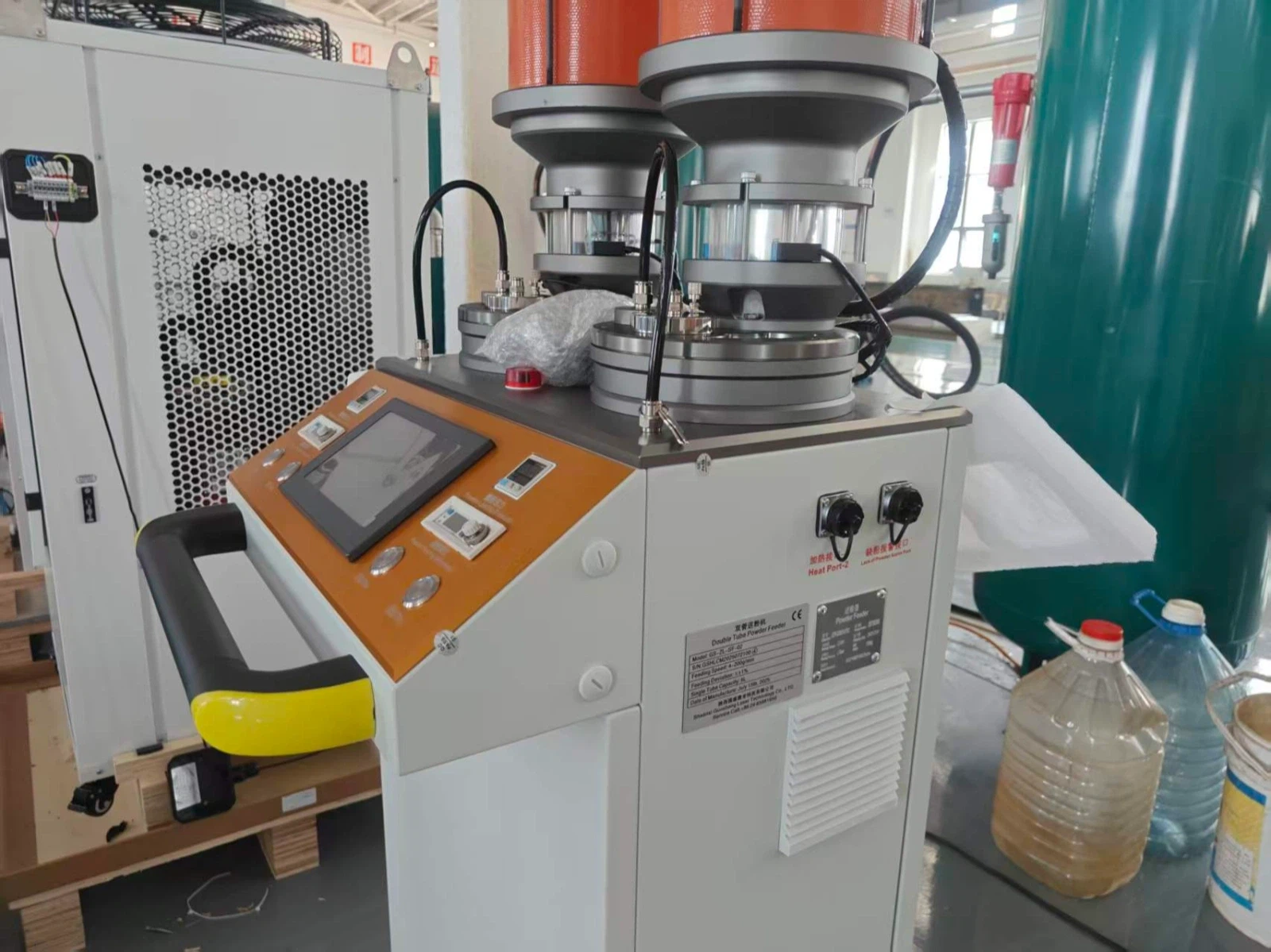
To address the cost and efficiency pain points of the laser cladding industry, the machine tool-type high-speed laser cladding equipment developed by Guosheng Laser has achieved a key breakthrough. This equipment is mainly used to replace the chrome plating process for shaft-type mechanical parts, with a deposition efficiency 3-5 times that of traditional laser cladding, fundamentally improving processing efficiency. The core of the equipment consists of a high-power laser, high-precision CNC machine tool, high-speed laser processing head, high-precision powder feeder, cooling system, and control system. At the same time, it enhances performance through three major optimized designs: a specially optimized high-speed laser cladding nozzle ensures high powder utilization, a large-capacity high-precision dual-barrel powder feeder guarantees powder feeding stability, and a high-precision CNC machine tool improves the uniformity of the cladding layer. These three elements work together to effectively reduce the comprehensive cost of laser cladding.

Six Core Performance Advantages of Guosheng Laser's Cladding Equipment
Guosheng Laser's machine tool-type high-speed laser cladding equipment demonstrates six core advantages in accuracy, efficiency, and applicability, further consolidating its industrial competitiveness. Firstly, it precisely controls laser energy, stably maintaining the cladding layer dilution rate within 3% to ensure cladding quality. Secondly, it has a high powder utilization rate- the specially designed nozzle enables a powder utilization rate of over 90%, reducing material waste. Thirdly, it ensures stable powder feeding and cladding- the dual-barrel powder feeder guarantees non-fluctuating long-term powder feeding and uniform cladding layers. Fourthly, it features outstanding processing efficiency- the cladding linear speed can reach 100-500mm/s, with a cladding area per unit time of 0.5-1m². Fifthly, it allows controllable coating thickness- the molten coating thickness can be precisely adjusted within the range of 0.2mm-10mm to meet different needs. Sixthly, it has a wide range of application scenarios- it can be used for laser cladding of shaft-type parts in industries such as coal mining (hydraulic props), petroleum (oil rods), printing (oil cylinders), engineering machinery (hydraulic rods), and electric power (boiler superheater tubes).
Existing Barriers for the Laser Cladding Industry to Become a Mainstream Process
Although laser cladding technology has significant advantages and is expected to become a mainstream process for industrial surface treatment in the long run, the industry still faces two key barriers to popularization. On one hand, the price of laser cladding products is relatively high, exceeding the acceptance range of most customers- especially small and medium-sized enterprises, which are cost-sensitive and cannot adopt it on a large scale. On the other hand, some users have doubts about the performance of laser cladding products, worrying that their stability and durability are not as good as traditional processes (such as chrome plating). This trust gap hinders the replacement process of "replacing electroplated columns with laser cladding columns", slowing down the market penetration of laser cladding.

Summary of Laser Cladding Industry Development and Future Trends
In summary, China's laser cladding industry is in a development stage "full of potential yet facing challenges". The most prominent current pain points are the disconnection between industry, academia, and research, and high costs. However, specialized equipment from enterprises like Guosheng Laser has provided a feasible solution for cost reduction and efficiency improvement. The high accuracy, high utilization rate, and wide applicability of its equipment are gradually breaking through the industry's technical bottlenecks. In the future, as equipment costs further decrease and users' trust in product performance improves, laser cladding is expected to accelerate the replacement of traditional processes and achieve large-scale application in more industrial fields. Nevertheless, the industry still needs to continuously promote industry-academia-research collaboration and optimize the cost structure to truly release the market potential of laser cladding technology and become a mainstream process.