

Ensuring Stability in Power Generation
In the power energy sector, turbine efficiency directly dictates a plant's economic performance. Turbine blades operate under extreme conditions, facing high-speed centrifugal forces, high-temperature steam erosion, and the constant threat of cavitation. Even minor surface damage can lead to increased vibration, significant efficiency drops, or unplanned downtime, resulting in massive financial losses. Guosheng Laser's advanced laser refurbishment technology provides a high-reliability solution for power plant maintenance. By using laser cladding to restore damaged blades with extreme precision, we help enterprises recover unit performance quickly, maximizing continuous uptime and significantly reducing long-term operational costs.

Superior Bonding: Laser Cladding vs. Thermal Spray and Welding
For precision rotating components like turbine blades, the reliability of the repair layer is paramount. Traditional TIG welding often introduces excessive heat, leading to thermal deformation and residual stresses. Conversely, while thermal spray has a low heat impact, it relies on a mechanical bond that risks delamination under high-RPM centrifugal forces. Guosheng Laser's cladding solution perfectly bridges this gap. It utilizes a high-energy laser to achieve a micro-level metallurgical bond, ensuring the coating remains secure under extreme stress. Because the laser beam is highly focused, the heat-affected zone (HAZ) is kept minimal, preserving the blade's original fatigue strength and grain structure.
Comprehensive Applications: From Steam Erosion to Gas Turbines
Our technology covers a wide range of complex working conditions within power plants. A standout application is the reinforcement of last-stage steam turbine blades against water erosion. By cladding high-performance Stellite alloys, we significantly boost wear resistance. Additionally, laser cladding is widely used for rotor journal repair, blade root refurbishment, and gas turbine component restoration. For gas turbines operating above 600°C, Guosheng Laser has developed specialized nickel-based and cobalt-based superalloy process packages. These provide exceptional oxidation and corrosion resistance, allowing high-value energy assets to return to full-load operation with "as-new" performance.


Extreme Precision and Intelligent Digital Control
Turbine repair requires surgical precision. Guosheng Laser's equipment integrates high-power fiber lasers with high-dynamic 5-axis or 6-axis robotic systems. Combined with 3D laser scanning technology, we achieve automated contour recognition and reverse modeling to generate precise repair paths. This digital "Scan-Model-Clad" closed-loop ensures that the repaired dimensions match the original design intent, drastically reducing the difficulty of subsequent dynamic balancing. Furthermore, our system supports real-time melt pool monitoring to ensure uniform quality in every layer, meeting the power industry's most stringent safety and precision standards for critical rotating machinery.
Guosheng Laser: Your Trusted Partner in Power Energy
As a leading Chinese provider of laser cladding solutions, Guosheng Laser operates a 10,000 m² production facility certified under ISO9001 and CE standards. We provide more than just hardware; we offer turnkey services ranging from custom material development to on-site technical guidance. Our factory-direct model, combined with world-class core components, ensures that power plant clients receive international-standard technology with a highly competitive ROI. From initial equipment selection to global after-sales response, Guosheng Laser is dedicated to assisting energy clients worldwide in maintaining efficient, stable operations in an increasingly competitive global market.

Laser equipment components

Fiber Laser Machine

Laser Cladding Head
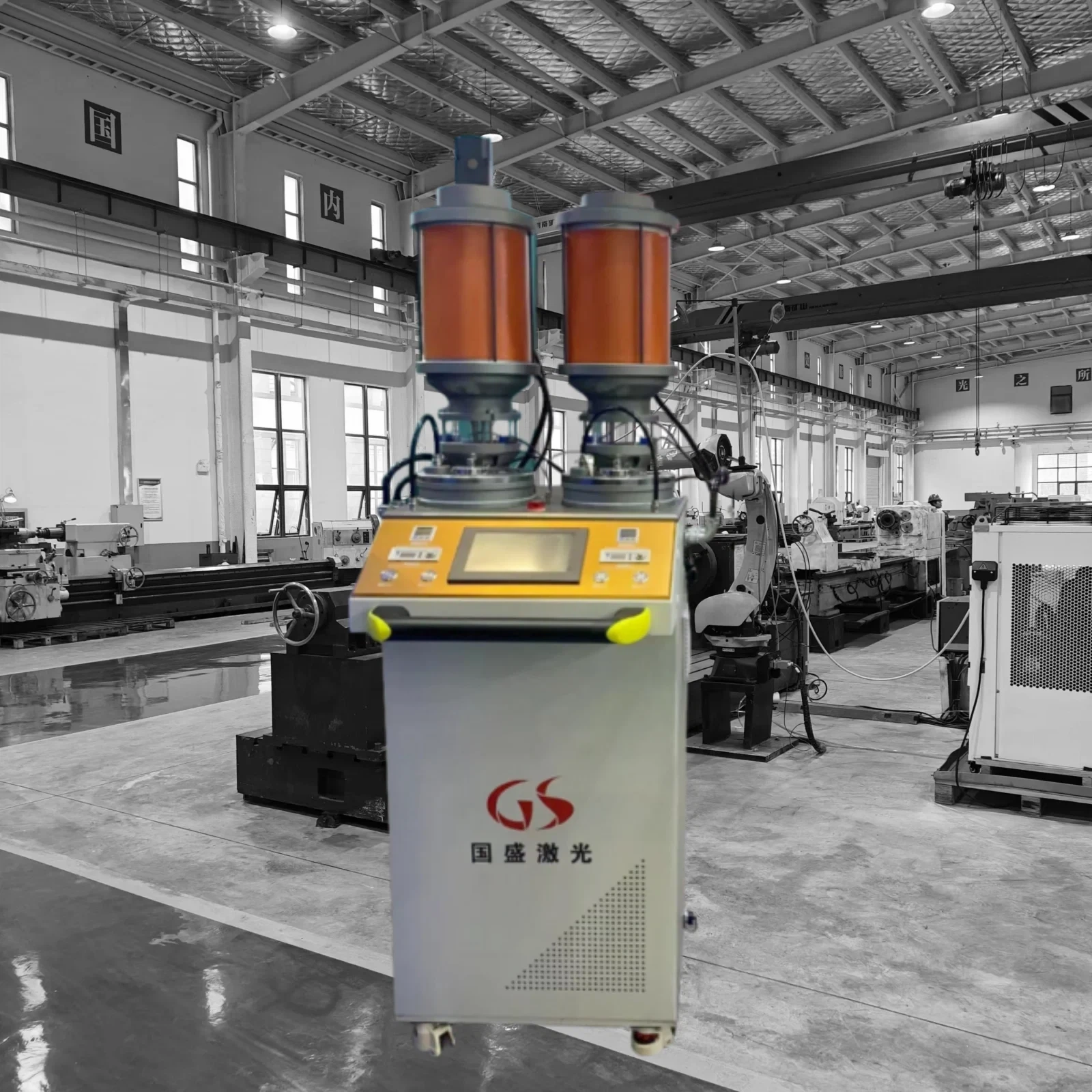
Powder Feeder

Laser Hardening Head
Industry Knowledge FAQ
Q: Do turbine blades need dynamic balancing after laser cladding?
A: Yes. Although laser cladding is extremely precise, we recommend finish machining and dynamic balancing to ensure absolute safety at high RPMs. Our process significantly reduces the amount of material removal and balance weighting required.
Q: Can laser cladding significantly extend the service life of blades?
A: Absolutely. By applying wear and corrosion-resistant layers, the service cycle can be extended by 2 to 3 times. The cost is typically only 20%-30% of purchasing a new blade.
Q: Is your equipment compatible with expensive nickel-based superalloys?
A: Yes. We have extensive experience with alloys like Inconel 718 and Hastelloy. Our optimized process parameters effectively prevent hot cracking, which is a common challenge with these materials.