

Overview of Laser Quenching Technology and Its Applications
In the field of surface strengthening for industrial manufacturing, laser quenching technology has become one of the core alternatives to traditional medium-high frequency quenching and carburizing quenching, thanks to its characteristics of "rapid heating and precise temperature control". The rise of laser cladding technology (which melts coating materials and the substrate surface layer using lasers to form a high-performance metallurgical bonding layer) has further promoted the synergistic application of "laser quenching + cladding". Their combination not only strengthens the substrate strength of parts but also improves wear resistance and corrosion resistance through the cladding layer, providing a new solution for the manufacturing and remanufacturing of high-end equipment parts. This article systematically sorts out the technical correlation, core advantages, typical applications, and key parameter control points of laser quenching and laser cladding, helping industry practitioners understand their technical value and practical implementation paths.

Technical Synergy Principle of Laser Quenching and Laser Cladding
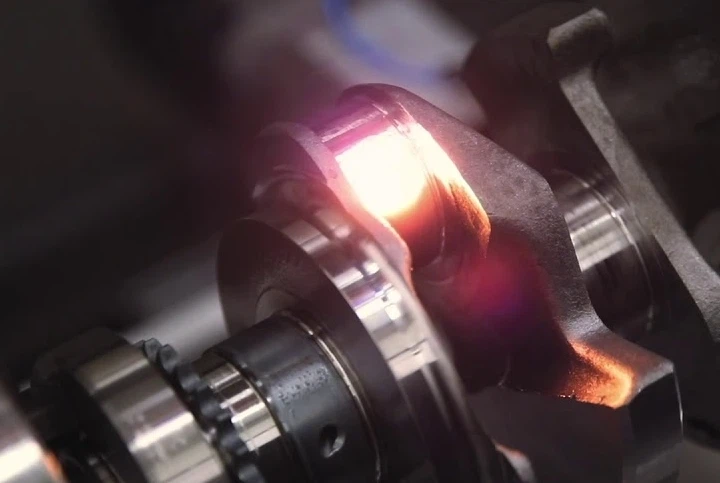
The synergy between laser quenching and laser cladding stems from their shared core heat source of "high-energy laser beams" and complementary operational logic: Laser quenching rapidly heats the part surface to the austenitizing temperature using a focused laser beam, then forms a martensitic hardened layer (to strengthen substrate hardness) through self-cooling of the substrate. Building on the quenching process, laser cladding synchronously feeds coating materials (such as metal alloys and ceramics) into the laser action area, causing the coating and the substrate surface layer to melt together and solidify quickly, forming a functional layer with metallurgical bonding to the substrate. This "quenching first to strengthen the substrate, then cladding to supplement performance" mode solves the problems of "insufficient corrosion resistance" with single quenching and "weak substrate support" with single cladding. For example, in cylinder liner processing, local quenching first strengthens the deformation resistance of the inner wall substrate, followed by cladding a nickel-based alloy layer to improve wear resistance, which can extend the part service life by more than 3 times.
Core Advantages of the Laser Quenching-Cladding Synergistic Process (Compared with Traditional Technologies)
Compared with traditional surface treatment technologies, the "laser quenching + cladding" synergistic process has four irreplaceable advantages: First, stronger deformation controllability - the laser beam has concentrated energy (power density reaching 10⁴~10⁶ W/cm²), and the heating area is limited to the surface layer (0.3~5mm), avoiding "part deformation caused by overall heating" in traditional carburizing quenching. It is especially suitable for deformation-prone parts such as thin-walled parts and precision gears. Second, more flexible material adaptation - laser cladding can use various coating materials such as stainless steel, tungsten carbide, and ceramics; combined with the strength of the quenched substrate, it can meet diverse needs such as "wear resistance, corrosion resistance, and high-temperature resistance". In contrast, traditional medium-high frequency quenching only improves hardness and cannot change the surface material properties. Third, better environmental performance - no cooling media (such as water or oil) are required throughout the process (quenching relies on self-cooling, and cladding produces no waste liquid discharge), avoiding the "medium pollution" problem of traditional quenching and complying with green production standards. Fourth, more precise local processing - by adjusting the laser spot size, it can achieve integrated "quenching + cladding" processing on complex parts such as blind holes, internal grooves, and tooth surfaces, solving the pain point of traditional inductor quenching being "unable to cover complex structures".


Typical Industrial Application Scenarios of Laser Quenching and Laser Cladding
Currently, the "laser quenching + cladding" technology has been widely applied in fields such as construction machinery, automotive manufacturing, and mold industry. Typical scenarios include: 1. Cylinder liner/piston rod repair - for wear and scratches on the inner wall of hydraulic equipment cylinder liners, local laser quenching first strengthens the substrate (hardness reaching HRC55~60), followed by cladding a stainless steel or alloy coating to restore dimensional accuracy while improving wear resistance; the repair cost is only 1/3 of that of replacement. 2. Mold edge strengthening - the edges of cold working dies are prone to chipping; through "quenching to strengthen substrate toughness + cladding a tungsten carbide coating to improve hardness", the mold service life can be extended by 2~4 times. 3. Large gear tooth surface processing - the tooth surfaces of wind power gears and mining machinery gears bear complex forces; laser quenching ensures the root strength, and cladding a nickel-based alloy layer improves tooth surface wear resistance, avoiding the "easy peeling of tooth surfaces" problem in traditional quenching. 4. Nuclear power/chemical equipment components - to meet corrosion resistance requirements, quenching first improves the substrate's stress corrosion resistance, then cladding Hastelloy or titanium alloy coatings to adapt to harsh working conditions.
Key Parameter Control Points for the Laser Quenching-Cladding Process
Precise control of process parameters is crucial to ensuring the effect of "laser quenching + cladding", with three key dimensions requiring focus: First, laser parameters - in the quenching stage, laser power (500~1500W) and scanning speed (5~20mm/s) need to be controlled to avoid substrate overburning caused by excessive power; in the cladding stage, the power needs to be increased to 1500~3000W, while matching the powder feeding rate (5~20g/min) to ensure sufficient metallurgical bonding between the coating and the substrate. Second, cooling rate - excessive cooling speed after quenching may cause cracks, which can be adjusted by inert gas protection (e.g., argon); slow cooling (e.g., furnace cooling) is required after cladding to reduce the thermal stress difference between the coating and the substrate. Third, material matching - the coating material must be compatible with the substrate material (e.g., low-carbon steel substrate matches 45# steel coating, stainless steel substrate matches 316L coating) to avoid coating peeling due to differences in thermal expansion coefficients. Meanwhile, "wear-resistant (tungsten carbide)" or "corrosion-resistant (Hastelloy)" coatings should be selected based on working condition requirements.
Development Summary and Outlook of the Laser Quenching-Laser Cladding Synergistic Technology
In summary, the synergistic application of laser quenching and laser cladding is essentially a combination of "substrate strengthening" and "surface function upgrading". It inherits the advantages of laser quenching (small deformation, high efficiency) and expands the performance boundaries of parts through laser cladding, solving the pain points of traditional surface treatment technologies (single function, poor adaptability). It has become a key technology driving the "high-end manufacturing and green remanufacturing" of industrial parts. In the future, with the development of intelligent laser equipment (e.g., AI-based automatic parameter adjustment) and innovative coating materials (e.g., nanocomposite coatings), the "laser quenching + cladding" technology will further lower application thresholds and achieve wider implementation in high-end fields such as new energy equipment and aerospace components, providing core support for the transformation and upgrading of the manufacturing industry.