


1. Severe Service Dilemma of Mining Single-Tooth Rolls
Single-tooth rolls are core crushing components in mining and steel plants, operating under heavy load, frequent impact, severe abrasion and high temperature. Original new rolls only serve 1 year, with tooth surfaces and bearing seats suffering rapid wear, peeling and dimensional loss. Traditional manual surfacing relies on handheld welding guns, bringing obvious drawbacks: uneven coating thickness, large thermal deformation, unstable bonding strength, long processing cycles and high labor costs. Outdated manual repair cannot meet the mass maintenance demand of large mining rotors.
2. Robotic Automation vs Manual Operation: Clear Data Gap
Robotic laser cladding systems replace traditional manual work with programmable six-axis manipulators. For a full-size single-tooth roll repair:
- Labor input: Manual repair requires 2 skilled workers spending 12 working hours; robotic equipment finishes the whole procedure in only 5 hours with one operator for supervision. Labor cost cuts by over 60%.
- Processing consistency: Manual surfacing has coating thickness deviation up to ±0.8mm; robotic laser cladding controls tolerance within ±0.15mm, eliminating uneven hard layers.
- Safety improvement: Workers avoid long-term exposure to high-temperature spatter and dust; robots complete all high-risk surface processing automatically.
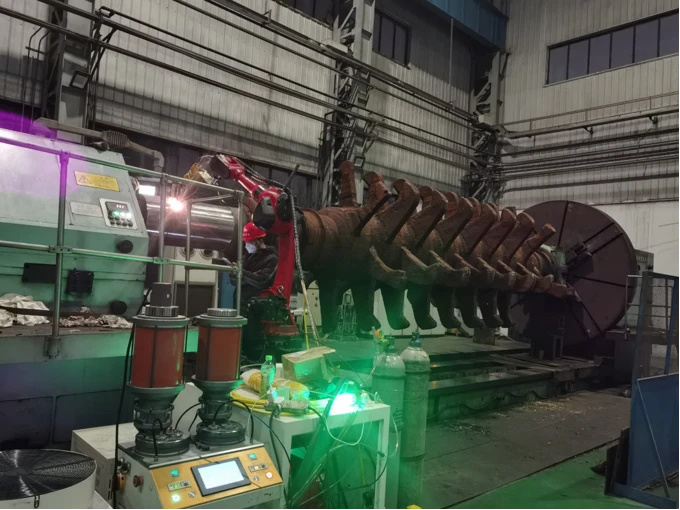

Laser cladding fuses high-performance wear-resistant alloy powder with the roll substrate to form dense metallurgical coatings. Site test data of single-tooth rolls shows:
- Service life: New original roll = 1 year; laser-clad repaired roll reaches 2–3 years, doubling or tripling running time.
- Maintenance expenditure: Repair cost of one roll is merely 45% of purchasing a brand-new rotor, greatly slashing spare part procurement expenses.
- Operational stability: The cladding layer resists abrasive particles and thermal fatigue. Repaired rolls run smoothly under full load without tooth collapse or surface peeling, cutting unplanned production downtime caused by frequent roll replacement.
Integrated robotic laser cladding combines automated operation and high-performance surface strengthening. It solves two core pain points of mining factories: low efficiency of manual repair and short service cycle of vulnerable heavy rollers. This green remanufacturing technology lowers overall operation costs, improves continuous mining production efficiency, and delivers remarkable economic returns for mineral processing plants.
