

Introduction to Advanced Roll Repair and Manufacturing
In the demanding operational environments of heavy industries like steel, aluminum, and rubber production, the durability and performance of large industrial rolls are critical determinants of efficiency and cost-effectiveness. Large roll laser cladding stands as a transformative industrial solution, revolutionizing traditional approaches to roll surface enhancement and repair. This advanced laser additive manufacturing process offers unparalleled precision and performance compared to conventional methods such as thermal spraying or submerged arc welding. This article provides a detailed exploration of the DED (Directed Energy Deposition) process tailored for rolls. It systematically covers the core technical principles, substantial operational and economic benefits, primary industrial applications, and essential factors for selecting optimal laser cladding equipment. For maintenance teams and OEM manufacturers aiming to drastically improve wear resistance, extend service cycles, and minimize production downtime, mastering this technology is becoming an indispensable strategic advantage in modern manufacturing.

The Technical Process of Directed Energy Deposition on Rolls
Large roll laser cladding operates on the principles of Directed Energy Deposition, a robust metal additive manufacturing technique. A high-power industrial laser, typically a fiber or diode laser system, generates a focused beam that creates a microscopic molten pool on the roll substrate's surface. Concurrently, a precision powder feeder delivers a controlled stream of specialized metal powder-commonly cobalt-base, nickel-base, or iron-base alloys-into this pool. The powder particles are instantaneously melted and metallurgically fused with the base material. As the laser cladding head traverses the surface, it deposits a dense, fully bonded layer with superior cohesion compared to mechanical bonds. The process is characterized by rapid solidification, resulting in a fine, homogeneous microstructure with minimal dilution and a narrow heat-affected zone (HAZ). Critical process parameters like laser power density, beam spot size, powder feed rate, and traverse speed are digitally controlled to achieve specific clad layer properties, including precise hardness, enhanced crack resistance, and optimal bonding strength, all customized for the roll's operational mill conditions.
Strategic Advantages for Industrial Performance and Cost Savings
The adoption of automated laser cladding systems for large rolls delivers compelling advantages that directly impact the bottom line. The foremost benefit is the creation of a true metallurgical bond between the clad layer and the roll substrate. This fusion bond is fundamentally stronger than the mechanical adhesion of thermal spray coatings, virtually eliminating risks of delamination or spalling under extreme rolling pressures and cyclic stresses. Secondly, the process is a low-heat-input solution. The concentrated energy source minimizes thermal distortion and preserves the core metallurgy of the expensive roll base, a common issue with high-heat arc welding processes. This precision allows for the restoration of complex geometries, including roll journals and grooves, without damaging adjacent areas. Thirdly, it offers exceptional material flexibility. Engineers can deposit advanced, custom alloy compositions that are difficult to process with other methods, creating composite structures that combine a tough, ductile substrate with an ultra-hard, wear-resistant working surface tailored to combat specific failure modes like abrasion, thermal fatigue, or corrosion.


Key Industrial Applications Across Manufacturing Sectors
This versatile laser surface engineering technology finds extensive application in core industrial sectors. In steel mill roll manufacturing and reconditioning, it is indispensable for rebuilding worn backup rolls, work rolls, and table rolls. Specific carbide-rich alloys are deposited to combat severe abrasive wear, rolling contact fatigue, and thermal shock, effectively addressing issues like fire cracking and spalling. For non-ferrous metal processing lines, such as aluminum or copper rolling, rolls are clad with specialized materials that resist adhesive material pickup (galling) and corrosion, ensuring a pristine, defect-free surface finish on the final strip or sheet product. Within the rubber, plastic, and printing industries, laser cladding protects large calendar rolls, embossing rolls, and anilox rolls from chemical degradation and wear. Beyond repair, the technology is pivotal for roll surface functionalization, applying precise textured or patterned coatings to impart specific topographies onto the processed material, a key process in automotive or appliance sheet production.
Essential Criteria for Selecting Laser Cladding Equipment
Investing in the right turnkey laser cladding system is crucial for achieving consistent, high-quality results on large rolls. The cornerstone is a reliable, high-power laser source, typically a continuous-wave fiber laser or direct diode laser in the 4kW to 10kW+ range, chosen for excellent beam quality, stability, and wall-plug efficiency. An equally critical component is a high-precision, closed-loop powder feeder and delivery system, which ensures a consistent, homogenous flow of spherical metal powder to the deposition head. The system requires a robust, multi-axis motion platform, often integrating a heavy-duty industrial robot or CNC gantry with a high-torque roll positioner or lathe to manipulate the cladding head accurately over large cylindrical surfaces. Advanced process control packages, featuring real-time co-axial melt pool monitoring, pyrometry, and height sensing, are essential for automated, repeatable quality assurance. Finally, the entire setup must be housed within a safety enclosure integrated with high-efficiency fume filtration to manage airborne particulates, ensuring operator safety and compliance with industrial health standards.

Laser equipment components

Fiber Laser Machine

Laser Cladding Head
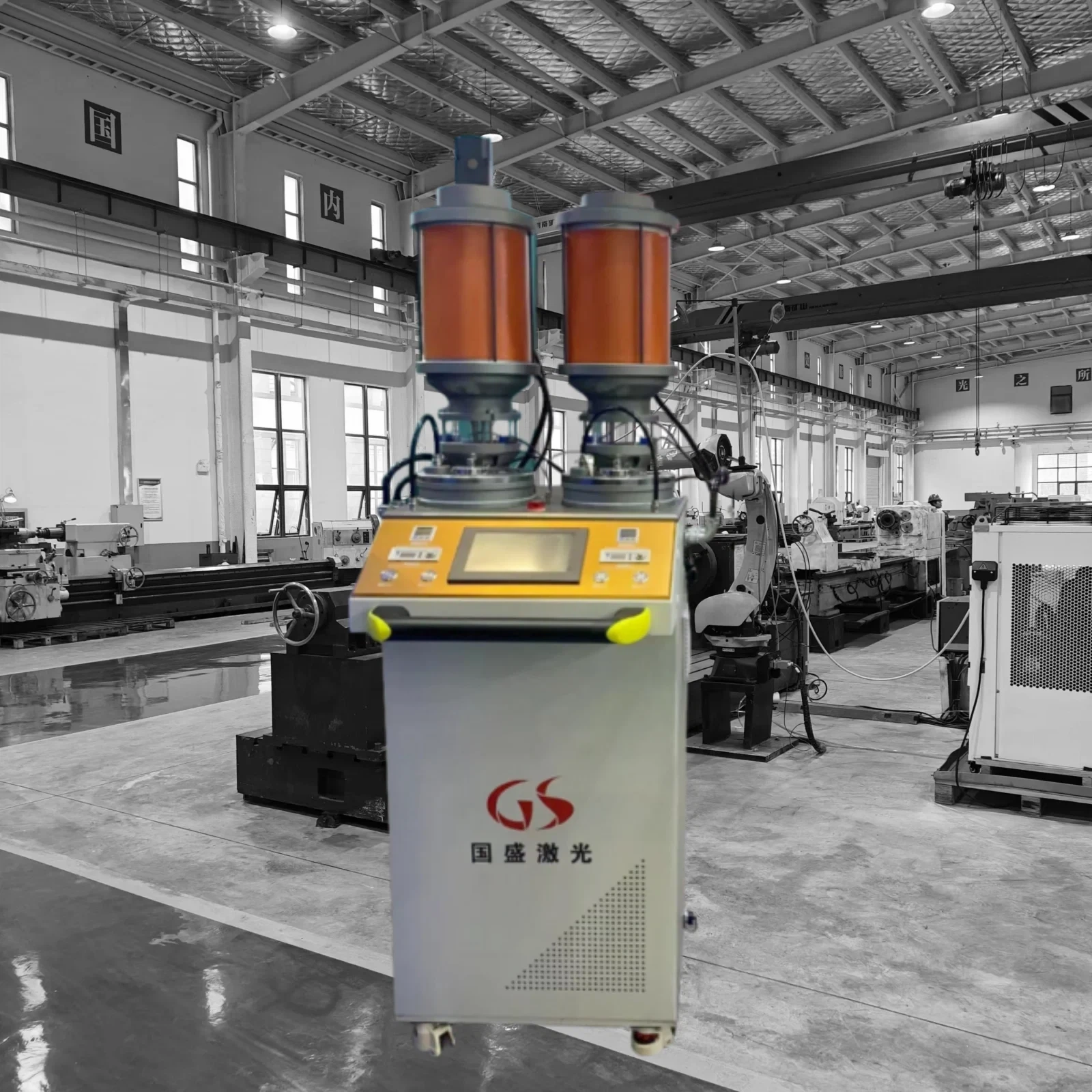
Powder Feeder

Laser Hardening Head
Investing in Long-Term Manufacturing Resilience
Large roll laser cladding represents a sophisticated and high-return application of industrial laser additive manufacturing, delivering a clear ROI through dramatically extended component life, reduced spare part costs, and improved product quality. Its strategic advantages-including superior metallurgical bonding, minimal thermal distortion, and unmatched material versatility-establish it as the premier choice for roll maintenance across foundational global industries. For organizations implementing this capability, success hinges on partnering with an experienced laser cladding equipment manufacturer who provides not only a robust, automated system but also comprehensive process development support. As global manufacturing emphatically shifts towards sustainable, circular economy models, the role of laser cladding in enabling high-value component remanufacturing and life-extension is set to expand, solidifying its status as a cornerstone technology for resilient, efficient, and competitive industrial operations.
FAQ
Q: What is laser cladding used for in heavy industry?
A: Laser cladding is primarily used to repair, rebuild, and enhance the surface of large, high-value industrial components like mill rolls, gears, and shafts. It deposits a wear-resistant, corrosion-resistant, or specialized alloy layer to extend service life and improve performance in steel, aluminum, and mining applications.
Q: How does laser cladding work on large rolls?
A: The process uses a high-power laser beam to create a melt pool on the roll's surface. Metal powder is simultaneously injected into the pool, where it melts and fuses with the base material. A robotic system moves the laser head to build up a precise, metallurgically bonded coating layer across the worn or damaged area.
Q: What are the main benefits of using laser cladding over traditional welding for roll repair?
A: Key benefits include a stronger metallurgical bond with minimal dilution, a much smaller heat-affected zone that prevents part distortion, the ability to apply advanced, hard-facing alloys, and precise process control for repeatable, automated repairs that reduce downtime and costs.