

Remanufacturing Technology Leading Steel Industry Transformation
In the highly competitive steel industry, cost reduction and efficiency enhancement are the ultimate goals for corporate survival and growth. From converter steelmaking to continuous casting and rolling, every process revolution has aimed to lower production costs. As metallurgical technology matures, Laser Remanufacturing Technology is emerging as a core driver of competitiveness. By performing surface strengthening on key components of metallurgical production lines, this technology not only endows new products with superior performance but also allows worn-out parts to "come back to life." Utilizing laser technology to extend product lifespans effectively reduces maintenance frequency and downtime, significantly boosting overall productivity while lowering material consumption.

Core Principle: Microscopic Transformation via Instant Heating and Self-Quenching
Laser quenching is an advanced heat treatment technology that utilizes a high-energy laser beam for material surface modification. Its basic principle involves using a focused laser beam as a high-power-density heat source to precisely irradiate the workpiece surface. Under this intense energy, the surface temperature of the part rises sharply within microseconds to milliseconds, rapidly exceeding the phase transition point to form austenite. Once the laser beam moves away, the heat is rapidly conducted into the interior due to the massive heat capacity of the substrate, achieving self-quenching at rates of tens of thousands of degrees per second. This ultra-fast cooling results in a hardened layer of martensite or other fine-grained structures with exceptional hardness.
Technical Features: Breaking the Physical Bottlenecks of Traditional Heat Treatment
Compared to traditional processes, laser surface quenching offers unparalleled technical advantages. First, its rapid heating speed and minimal heat-affected zone (HAZ) mean component deformation is almost negligible, allowing it to serve as the final step after precision machining. Second, the laser's exceptional spatial control enables it to handle complex geometries like blind holes, inner bores, and small grooves, overcoming the limitations of induction quenching regarding inductor shapes. Furthermore, laser quenching is a green and eco-friendly process that requires no cooling media like water or oil. For high-carbon steel or cast iron, it produces a finer microstructure and superior wear resistance, with hardening depths precisely controlled between 0.3 and 2.0 mm.

Industry Applications: Performance Rebirth for Rollers and Hearth Rolls
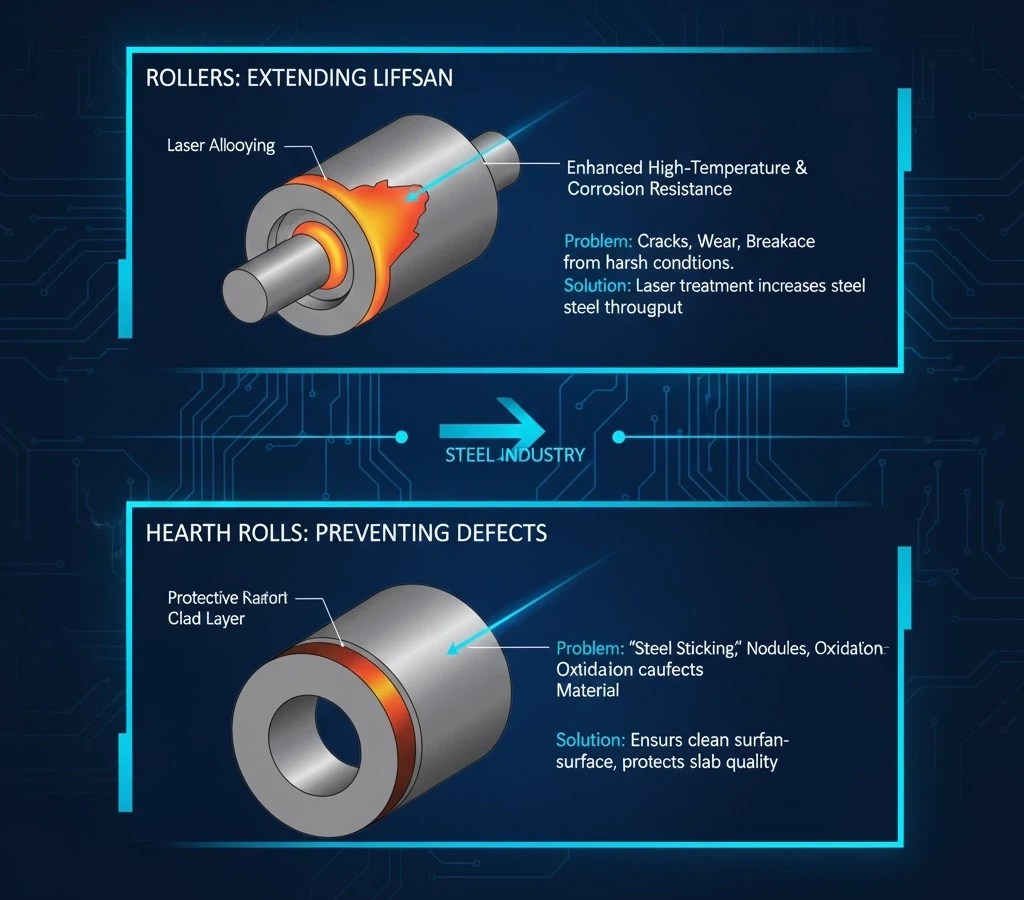
In steel production, rollers and furnace hearth rolls are among the components subject to the most severe wear. Rollers operating under harsh conditions are prone to cracks or fractures; through laser alloying, their high-temperature and corrosion resistance can be significantly enhanced, improving steel throughput. For hearth rolls, which stay in contact with high-temperature slabs, surfaces are susceptible to nodules, oxidation, and "steel sticking," which cause scratches on the final steel plates. Using laser quenching to apply a layer of wear-resistant and anti-oxidative material on the roll ring effectively prevents nodulation, protecting the surface quality of the billets and ensuring stable production line operation.
Value Analysis: The Economics of Extended Lifespan and Reduced Downtime
The core value of laser quenching in the steel industry lies in its high economic benefit. Because the wear resistance of treated parts is improved, the replacement cycle for core components is multiplied, directly lowering the procurement costs of spare parts. More importantly, laser repair technology reduces unplanned downtime caused by equipment failure, ensuring continuous production line operation. When processing large components, the laser process is not restricted by furnace dimensions; the ability to perform flexible on-site processing greatly reduces logistics and handling costs. This precise, efficient, and low-carbon processing method not only increases the added value of steel products but also creates significant emission reduction space through resource recycling.

Laser equipment components

Fiber Laser Machine

Laser Cladding Head
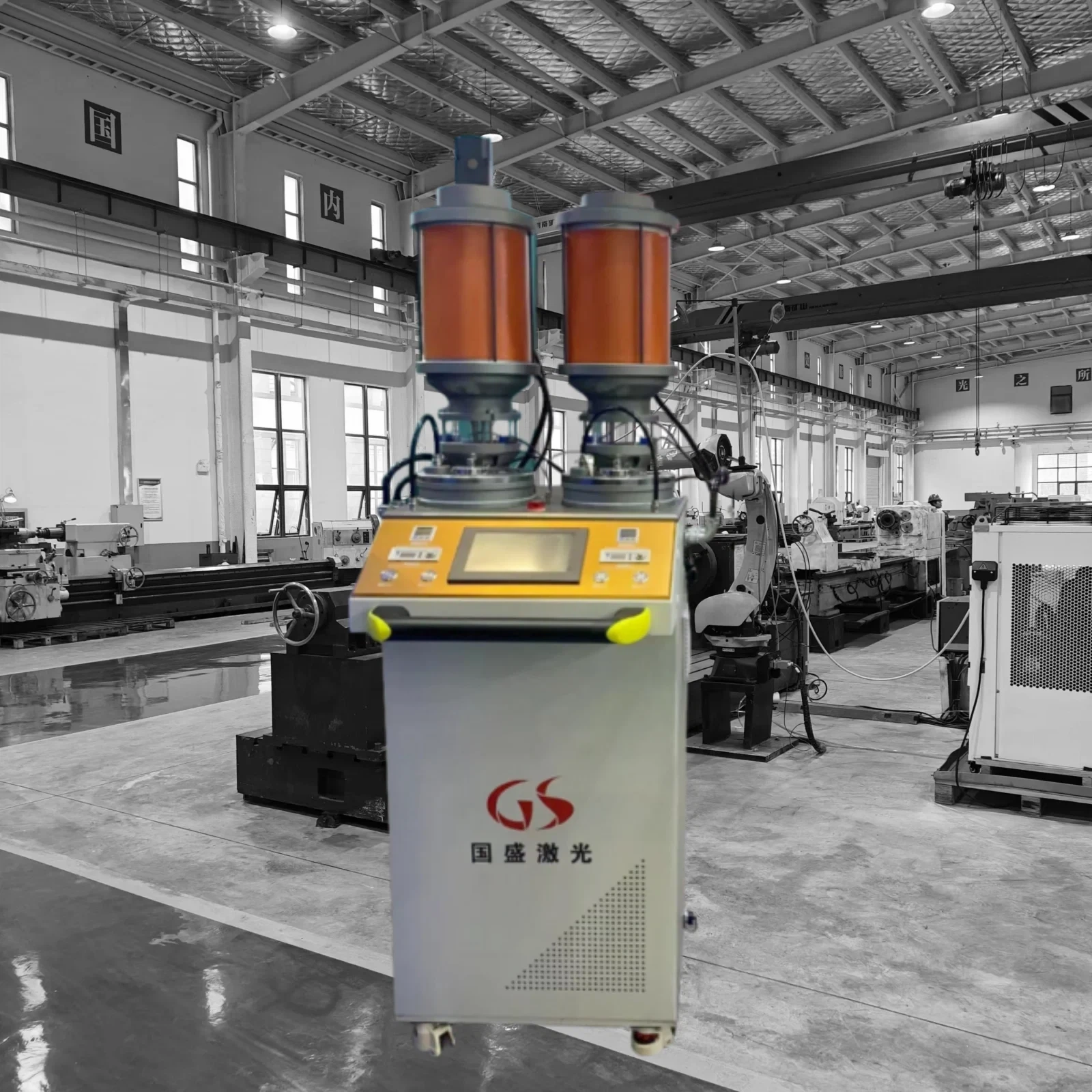
Powder Feeder

Laser Hardening Head
The Future of Laser Heat Treatment in Smart Manufacturing
In summary, laser quenching technology, with its characteristics of high precision, low deformation, and environmental friendliness, has become an essential tool for remanufacturing and efficiency enhancement in the steel industry. It not only solves the technical challenges of surface strengthening for complex parts but also plays an irreplaceable role in improving production efficiency and product quality. With the deep development of Smart Manufacturing and Industry 4.0, laser heat treatment will further integrate with automation and digital technologies. In the future, laser quenching will expand into the processing of more high-value alloy materials, continuing to drive the steel industry toward a more efficient, green, and high-end production model.