

Common types of industrial lasers include solid-state lasers, CO2 lasers, and fiber lasers. With the continuous breakthrough of laser technology, the power is constantly improved, the application field of lasers is more extensive, and the division of use of lasers has become clear.
The original YAG solid-state laser used for small and medium power welding is also suitable for fiber lasers. The original axial flow CO2 laser, which is good at medium and high-power cutting metal, is also suitable for fiber lasers. Semiconductor lasers is suitable for high-power welding, because fiber lasers use auxiliary swing welding to overcome the difficulties, which can also be applied. Fiber lasers pose similar challenges to other types of lasers in the field of precision laser processing.
Fiber lasers are popular because of their high applicability and low cost. Laser manufacturers are also constantly pushing up product power, from 10,000 watts, 20,000 watts to 40,000 watts. Not long ago, Chuangxin Laser announced the launch of 50,000 watts of commercial fiber lasers. So far, the more mature application of fiber lasers is still laser cutting, more accurately, the front-end cutting of metals. It can be said that laser welding has not been fully explored. The application of welding can be used from the processing of front-end components to the molding of back-end products. In theory, the market is broader, because its processing technology has certain technical requirements, and needs to be driven by precise processing needs, it is often customized laser welding equipment. So where is the most potential development of high-power laser welding in the future?
New energy laser processing
At present, when it comes to new energy, many people think of new energy vehicles and batteries. Strictly speaking, new energy is clean energy, including wind energy, water energy, solar energy, nuclear energy, etc., the final use of electricity, storage equipment and batteries, which can be regarded as new energy products.
China attaches great importance to the development of wind energy. Originally, with the western development of the Great Northwest as the key region, it was later found that the use of the market and population concentration of the eastern and southern coastal areas, so in recent years, the development of wind energy has shifted to coastal cities. Guangdong plans to invest nearly $1 trillion in coastal wind farms over the next 20 years. Windmill blades, rotors, bases, generators, tower barrels, etc. are the main components of wind power equipment, tower barrels, bases and other large components of metal need a lot of high-power welding. Thickness of more than 20mm or even 50mm, can be applied to 10,000 watts of laser welding, even 40,000 watts of laser welding are in demand. At present, there have been attempts to use 32,000 watts of laser for processing wind power equipment.

Water energy is mainly hydropower station. Pumps, turbines, motors, blade repair, etc., are commonly used in high-power laser welding, and are generally applicable to lasers above 4KW. Among them, the application of pump laser welding is the most mature, and the kilowatt-level welding of small pumps has developed to the 10,000-watt laser welding of large pumps, and the application space is broad. Nuclear power plants have more pipelines, large storage tanks, and reactor internals, which can be widely used in high-power laser welding. Due to the radiation risk of radioactive materials, the safety of nuclear power is the most important, so the metal walls such as pipes and storage tanks are relatively thick, requiring higher power welding, which can be achieved with more than 10KW lasers.
Laser welding requirements for new energy vehicles
As mass consumer goods, automobiles go into thousands of households, and the extent of its adoption of new technology also reflects the quality of automobiles to a certain extent. Automotive laser applications include body structure welding, automotive interior laser processing and automotive power battery welding. Traditional fuel car body laser welding has a certain penetration application in China, and the current use of laser processing in the production line of electric vehicles is still less. The laser processing in the frame and automotive interior will replicate the process of fuel vehicles, and gradually increase the use of laser in the future. It is expected that the domestic electric vehicle production and sales will exceed 3 million in 2022, and it is only a matter of time before the laser enters the electric vehicle production line in the future. Laser welding body generally uses 4KW, 6KW beams and above, which brings new requirements to the high power automatic laser welding.
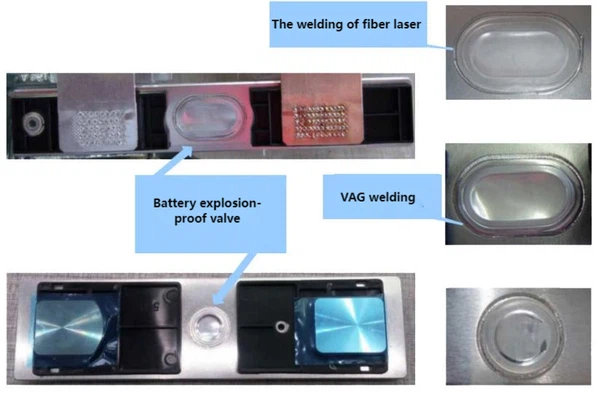
Laser processing of power batteries is the focus and difficulty of new energy vehicle technology at present. Laser welding mainly includes electrode lug welding (including pre-welding), electrode belt spot welding, battery into the shell pre-welding, shell top seal welding, liquid injection port seal welding, battery PACK module connection plate welding, and explosion-proof valve welding on the cover plate behind the module.
Power battery is one of the most important new growth points of laser equipment enterprises in recent years. In fact, it also brings more than 5 billion yuan per year of medium and high-power automated laser special equipment. The processing of power batteries generally requires more than 2KW of medium power, especially the aluminum alloy package of the battery shell may also use higher power, and the demand will continue to increase.
Marine fabrication drives high power laser welding
This year, the demand of many traditional laser processing industries is slightly weak, but ship manufacturing is a bright spot, driven by the increase in international shipping demand, and ship orders are rising. China's shipbuilding industry is huge and ranks first in the world. The cutting and welding processing needs of the ship's steel plate are large, and the thick plate above 10mm and the ultra-thick plate of 30mm are required for large ships. At present, laser welding has been applied in Dalian, Shanghai, Wuhan and other shipyards, with high-power laser composite welding as the main application.
In mid-August, the construction of the second domestic large cruise ship H1509 officially started in Shanghai Waigaoqiao Shipbuilding Co., LTD., China State Shipbuilding Corporation. Waigaoqiao Shipbuilding built the first intelligent production workshop dedicated to cruise ships in China, introduced T-BEAM assembly line equipment and eight welding robots, and innovatively adopted laser cutting, laser composite welding and other technologies. Two years ago, China Merchants Steamship has established a laser processing center for large cruise ships in Nantong Haimen. It can be seen that the application of high-power laser welding in the shipbuilding industry will make a great difference, and it is one of the important battlefields of 10,000-watt lasers.

Xi'an Guosheng Laser Technology Co., Ltd. is a high-tech enterprise specializing in R&D, manufacturing and sales of automatic laser cladding machine, high-speed laser cladding machine, laser quenching machine, laser welding machine and laser 3D printing equipment. Our products are cost-effective and sold domestically and abroad. If you're interested in our products, please contact us at sales@gshenglaser.com.