

The Key Process to Enhance the Performance of High-Temperature Rotary Shafts in Metallurgy
This article aims to systematically explain the core principles, process flow, and significant value of laser cladding strengthening technology in the application of high-temperature rotary shafts in the metallurgical industry. It will provide an in-depth analysis of how this technology addresses surface damage issues of rotary shafts under high-temperature, heavy-load, and corrosive working conditions through its excellent metallurgical bonding and rapid processing characteristics. This significantly extends equipment service life, reduces maintenance costs, and ensures production continuity, offering an efficient and reliable strengthening and repair solution for equipment management in metallurgical enterprises.

The Technical Core: Metallurgical Bonding and Rapid Forming
Laser cladding strengthening technology utilizes a high-energy-density laser beam to instantaneously melt specially selected alloy powder, delivered simultaneously, along with a thin surface layer of the substrate. This mixture then rapidly solidifies to form a strengthening coating firmly bonded in a metallurgical manner. Its core advantages lie in its extremely high bond strength and minimal heat-affected zone. The coating achieves a metallurgical bond at the atomic level with the substrate, with bond strength reaching or even exceeding that of the substrate itself, thereby avoiding the peeling issues common with traditional coatings. Furthermore, due to its extremely fast heating and cooling rates (up to 10^6 °C/s), the heat input is concentrated and controllable. This allows the depth of the heat-affected zone to be precisely controlled within 3% of the substrate's dimension, maximizing the reduction of workpiece distortion and degradation of the substrate's microstructure and properties. This makes it particularly suitable for repairing heat-sensitive or structurally precise rotary shafts.
The Application Imperative: Addressing Challenges in Extreme Conditions
High-temperature rotary shafts in the metallurgical industry operate for extended periods under extreme conditions involving high temperatures, heavy loads, dusty environments, and corrosive media. Issues like surface wear, corrosion, and thermal fatigue lead to loss of precision, performance degradation, and become key weaknesses affecting the stability of entire production lines. Traditional repair techniques like overlay welding involve high heat input, easily causing workpiece distortion and cracking, while technologies like thermal spraying suffer from insufficient coating adhesion. The introduction of laser cladding technology precisely compensates for these shortcomings. It can produce strengthening layers with low dilution rates (typically <5%), free from pores and slag inclusions, and with a dense microstructure. While precisely restoring component dimensions, it specifically enhances surface hardness, wear resistance, corrosion resistance, and high-temperature oxidation resistance. It represents an essential technological choice for fundamentally improving the service life of rotary shafts.


Process Essentials: Analysis of Five Key Steps
A complete laser cladding strengthening process encompasses five meticulously controlled stages, all indispensable. First, rigorous surface pre-treatment includes thorough cleaning, degreasing, and rust removal, along with turning or grinding the worn area to provide a clean, active surface for metallurgical bonding. Second, the scientific selection and preparation of coating materials requires choosing nickel-based, cobalt-based, or iron-based alloy powders based on the actual working conditions (temperature, load, medium) of the rotary shaft, often incorporating ceramic phases like tungsten carbide for high-temperature wear-resistant applications. Third, optimization of cladding process parameters requires precise coordination of laser power, scan speed, spot size, and powder feed rate to ensure forming quality and low dilution. Fourth, necessary post-processing involves grinding and polishing to eliminate surface stress concentration points, with stress relief annealing applied when needed. Finally, strict performance evaluation verifies the strengthening effect through methods like hardness testing, metallographic analysis, and wear testing.
Value Demonstration: Significant Benefits and Industry Cases
Laser cladding strengthening technology delivers tangible, measurable economic and production benefits for metallurgical enterprises. Application cases show that after treatment with this technology, the surface hardness of high-temperature rotary shafts can be increased to above HRC 50-55, wear resistance improved several-fold, and they can withstand high-temperature oxidation above 900°C. For example, after a domestic large steel company applied laser cladding with a nickel-based alloy to strengthen a sintering rotary shaft, its continuous service life extended from an average of 6 months to over 18 months. A single repair saved millions in direct losses and maintenance costs caused by frequent downtime for replacements. In another case involving the repair of a rolling mill drive shaft, using laser cladding instead of traditional overlay welding reduced the component's crack sensitivity by over 70%, significantly extending maintenance intervals and effectively ensuring stable and efficient production.

Laser equipment components

Fiber Laser Machine

Laser Cladding Head
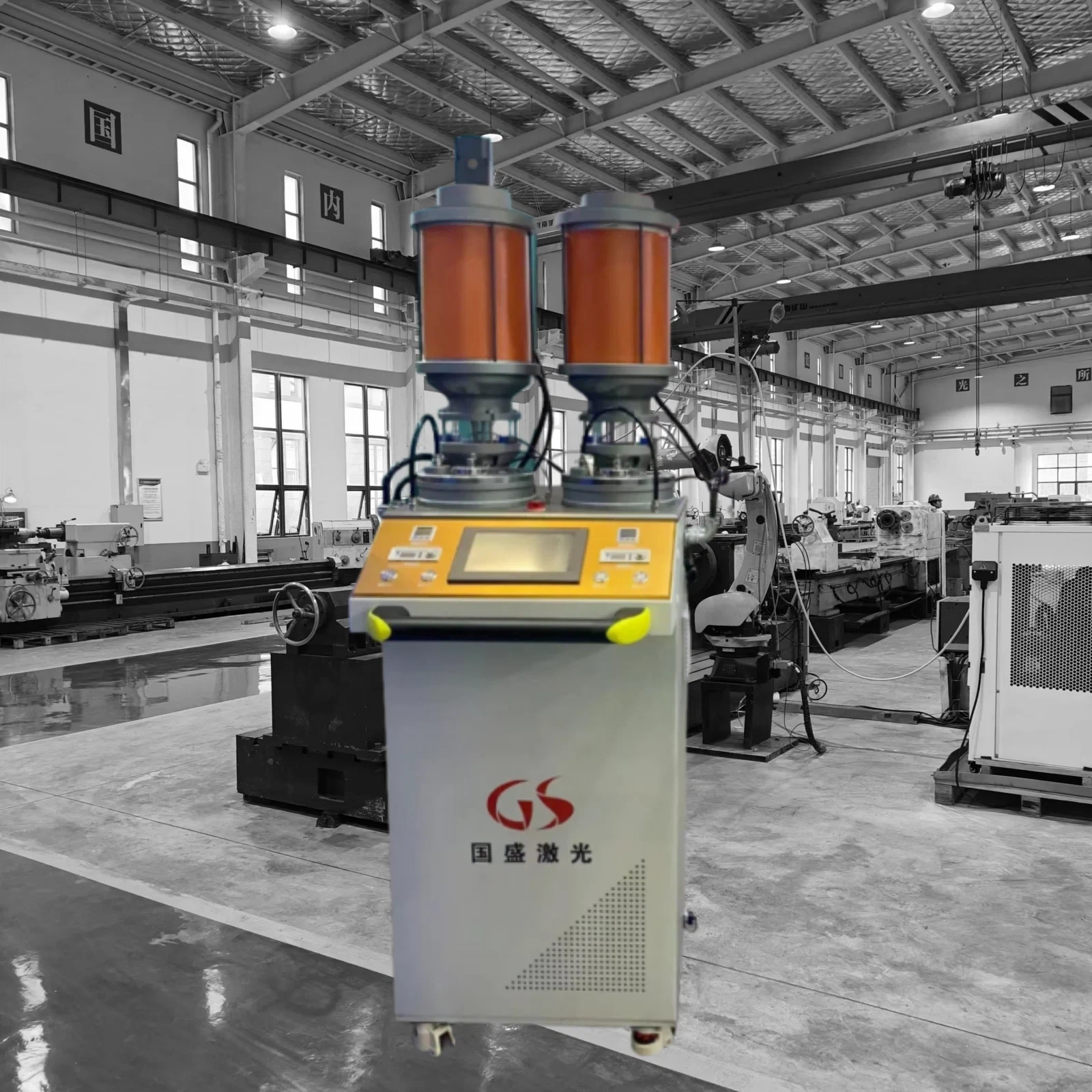
Powder Feeder

Laser Hardening Head
Conclusion and Outlook
In summary, laser cladding strengthening technology, with its outstanding features of high bond strength, minimal thermal impact, excellent coating performance, and good processing flexibility, has become one of the optimal processes for addressing surface damage and enhancing the performance of high-temperature rotary shafts in metallurgy. It not only significantly extends the service life of critical components and reduces comprehensive maintenance costs but also powerfully ensures the stable and efficient operation of production lines. With the continuous development of specialized alloy powders, the intelligent online monitoring of the process, and the increasing maturity of industry standards, laser cladding technology is destined to play an even more central role in the remanufacturing and high-performance enhancement of metallurgical equipment, providing enterprises with sustained competitive advantages.