

A Green New Engine for Reshaping Manufacturing and Repair
Driven by both intelligent manufacturing and green remanufacturing, laser cladding technology, with its core advantages of high efficiency, cost-effectiveness, and environmental friendliness, is rapidly penetrating key industries such as automotive, metallurgy, and electric power from niche areas like mold repair and component strengthening. As an advanced technology that achieves metallurgical bonding of materials through a high-energy-density laser beam, it can not only prepare high-performance alloy coatings on low-cost substrates, reducing the consumption of rare metals, but also, with its low-pollution and low-deformation characteristics, become a core solution to solve the problems of high cost and high loss in traditional manufacturing. This article will deeply analyze the application value, process key points, technical advantages, and industrial practices of laser cladding technology, demonstrating its core role in promoting the upgrading of the manufacturing industry.

Core Competitiveness Leading Manufacturing Upgrading
Laser cladding stands out for combining performance and economic value. Its cladding layers feature uniform, refined structures, ultra-low defects (no voids/cracks), and hardness of 50-62 HRC, with far superior wear/corrosion resistance. The coating achieves over 95% metallurgical bonding strength with the substrate, and gradient structures (base/middle/outer layers) can be customized for complex conditions. It offers high flexibility: 0-10 mm adjustable thickness, compatibility with metals, alloys, cermets (coatings) and steel/cast iron (substrates). Critically, the substrate has a small heat-affected zone and minimal deformation-only slight surface melting occurs, eliminating correction steps. These advantages reduce component repair costs by 60-80% vs. replacement while saving rare metals.
Development History and Application Expansion
Laser remanufacturing technology originated in the 1970s. In 1974, American researcher Gnanamuthu first achieved laser cladding on a metal substrate. In 1981, the British company Rolls-Royce applied laser cladding technology to repair aero-engine blades, marking its entry into the industrial application stage. Since the reform and opening up, the introduction of foreign high-end equipment and the repair needs for major engineering projects have provided opportunities for the development of laser remanufacturing technology in China. In recent years, the application scope of laser remanufacturing technology in China has expanded from aviation and defense to over ten industries including mining machinery, energy power, and metallurgical equipment. Nearly 300 laser remanufacturing enterprises have been established in China, forming a collaborative development pattern involving universities, research institutes, and industrial enterprises, promoting the leapfrog development of this technology from a research focus to industrial application.


Industrial Application Practices from Automotive to Electric Power
Laser cladding has expanded beyond molds, delivering large-scale value across industries. In automotive, Germany's TRUMPF uses dual-spot cladding for new energy vehicle brake discs, solving rust and dust issues, meeting Euro 7 standards, and boosting powder utilization to over 85%. In metallurgy, a steel mill repaired high-carbon high-chromium hot-rolling rolls with WC-Co composite powder; post-cladding, roll hardness reached HRC 62-65, service life extended from 3 to 8-10 months, and repair costs were just 20% of new rolls. In power, a thermal plant strengthened 1Cr13 turbine blades with NiCrBSi coating (nano-Al₂O₃ added), cutting erosion rate from 0.15 to 0.03 mm/10,000 hours and restoring efficiency. These cases confirm its industrial adaptability and economic merit.
Enterprise Technological Breakthroughs Lead Industrial Development
Equipment R&D breakthroughs drive laser cladding's popularity, with enterprises launching specialized solutions. Guosheng Laser's high-speed equipment has 5-10x the power density of conventional models; its mobile system eliminates off-site disassembly/transport, saving labor, time, and costs. Its 8-axis linkage equipment adapts to diverse workpieces via custom robots, positioners, or turntables. In addition, Guosheng Laser has also launched 15KW and 20KW powder melting and fuse equipment. Its unique center feeding technology solves the problem of powder sticking and blockage under 10,000 watts of power. The 10KW fuse equipment has a fuse volume of nearly 10 kilograms per hour, which is several times higher than similar technologies. These device innovations not only improve processing efficiency, but also lower the technological application threshold, promoting laser cladding from high-end customization to large-scale applications.

Laser equipment components

Fiber Laser Machine

Laser Cladding Head
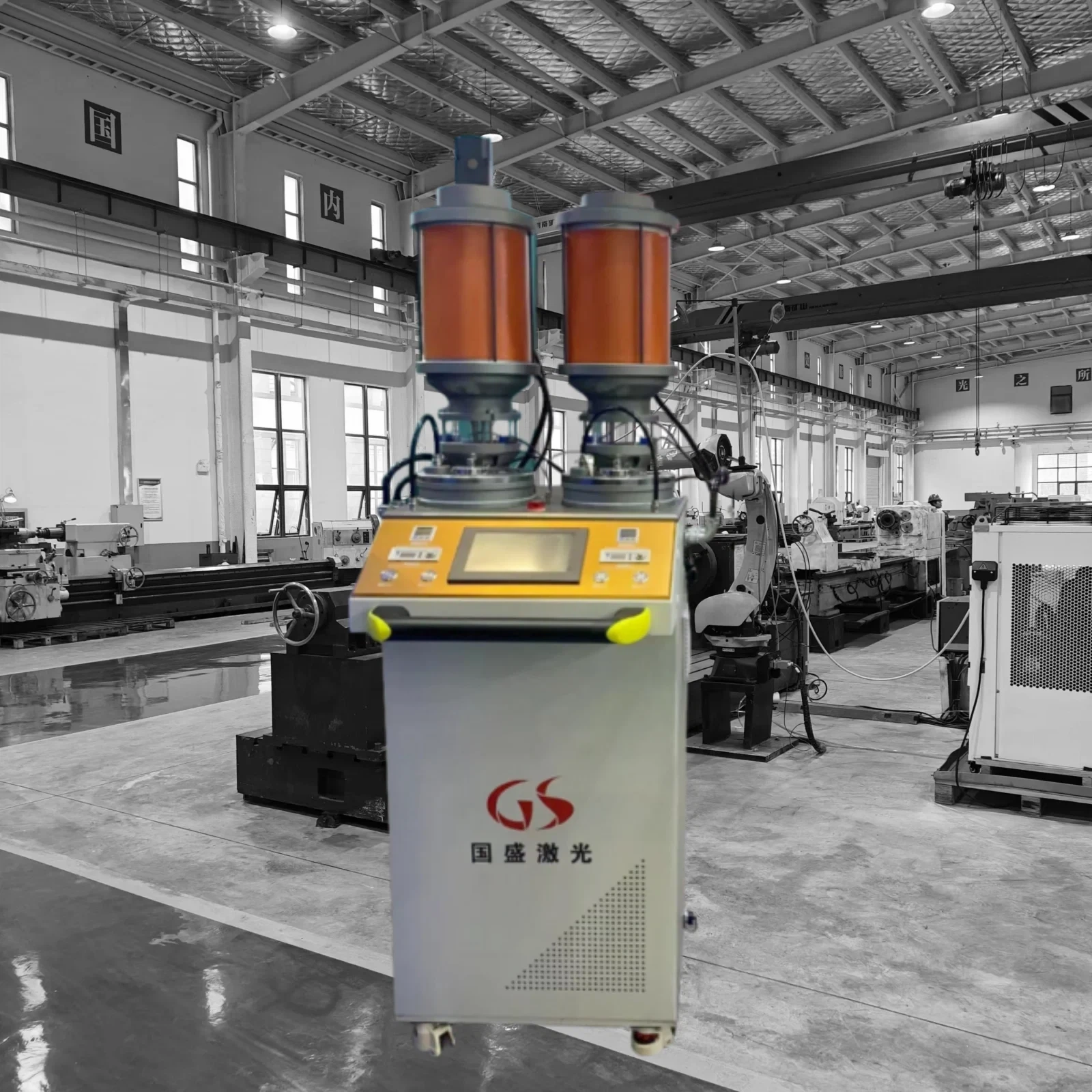
Powder Feeder

Laser Hardening Head
Laser Cladding Starts a New Journey of Green Manufacturing
Laser cladding, valued for "cost reduction, efficiency, and environmental protection", links traditional and advanced manufacturing. It solves manufacturing pain points (component wear, resource waste) through standardized mold repair, cross-industry applications (automotive/metallurgy/power), and equipment innovation, aligning with green remanufacturing trends. As 10,000-watt equipment becomes popular, costs fall, and scenarios expand, it will break technical barriers to excel in high-end equipment manufacturing and old equipment repair. Future equipment-process synergy will make laser cladding a core engine for high-quality manufacturing development, fueling industrial upgrading.