

Using Lasers as the "Pen" and Metal Powder as the "Ink"
Laser remanufacturing technology is an advanced repair technology with laser cladding at its core. It integrates laser processing, materials science, and digital technologies. It can not only restore the geometric dimensions of damaged components but also enable their performance to meet or even surpass that of new products. This technology is characterized by high quality, efficiency, energy saving, material conservation, and environmental protection, making it a key force driving green industrial development. With the "Made in China 2025" strategy highlighting green manufacturing as a key project, laser remanufacturing has received strong policy support. It is estimated that the scale of China's laser remanufacturing industry is expected to reach 10 billion yuan by 2025, indicating huge market potential and actively reshaping the circular utilization ecosystem of the manufacturing industry.

Technical Principles and Comparative Advantages
The technical foundation of laser remanufacturing is laser cladding, which forms a metallurgically bonded layer on the substrate surface using a high-energy laser beam to melt the cladding material. This technology offers significant advantages over traditional repair methods: a small heat-affected zone minimizing workpiece deformation; low dilution rate of the cladding layer with precise control; dense microstructure of the cladding layer with few microscopic defects; and high metallurgical bonding strength with the substrate. Materials commonly used in laser remanufacturing include Co-Cr based, Ni-Cr based, and Fe-Cr based alloy powders, and ceramic materials can be added to form metal-ceramic coatings. Compared to traditional technologies like thermal spraying, the laser-repaired layer forms a metallurgical bond with the substrate, resulting in a uniform and fine internal structure that eliminates defects like pores, cracks, and slag inclusions, whereas thermally sprayed coatings are mechanically bonded and contain numerous pores.
Development History and Application Expansion
Laser remanufacturing technology originated in the 1970s. In 1974, American researcher Gnanamuthu first achieved laser cladding on a metal substrate. In 1981, the British company Rolls-Royce applied laser cladding technology to repair aero-engine blades, marking its entry into the industrial application stage. Since the reform and opening up, the introduction of foreign high-end equipment and the repair needs for major engineering projects have provided opportunities for the development of laser remanufacturing technology in China. In recent years, the application scope of laser remanufacturing technology in China has expanded from aviation and defense to over ten industries including mining machinery, energy power, and metallurgical equipment. Nearly 300 laser remanufacturing enterprises have been established in China, forming a collaborative development pattern involving universities, research institutes, and industrial enterprises, promoting the leapfrog development of this technology from a research focus to industrial application.


Key Technological Breakthroughs and Innovation
Laser remanufacturing equipment has undergone technological evolution from CO2 lasers to fiber lasers and semiconductor lasers. New laser equipment offers higher flexibility and shorter wavelength characteristics, promising broader application prospects. Energy-field-assisted laser remanufacturing has become an important means for high-quality remanufacturing. By introducing external energy fields such as electromagnetic fields, induction heating fields, and ultrasonic vibration, it can effectively regulate molten pool flow, suppress pores, and control microstructure. To meet on-site remanufacturing needs, researchers have overcome full-angle laser cladding technology, achieving laser repair at different inclination angles. However, laser remanufacturing still faces challenges such as the limited variety of dedicated materials and reliance on imports for core equipment and components, which constrain further industrial development.
Industry Applications and Economic Benefits
In the mining machinery industry, laser remanufacturing technology is used to repair key components like crusher main shafts and hydraulic support columns. The service life of a repaired main shaft can be increased by 2-3 times. In the steel industry, the technology is applied to repair rollers. The performance of repaired rollers is improved several times compared to traditional processes, at only one-third the price of a new roller. In the petrochemical and power industries, laser remanufacturing is used to repair key equipment like gas turbines and steam turbines, costing less than 10% of new equipment. According to statistics, the annual volume of scrapped hydraulic support columns in China is about 450,000 tons. Using laser cladding remanufacturing technology could save 190,000 tons of standard coal annually and significantly reduce atmospheric pollution. This technology can save 40% in costs, 60% in energy, 70% in materials, and reduce emissions by 80%, offering significant economic and environmental benefits.

Laser equipment components

Fiber Laser Machine

Laser Cladding Head
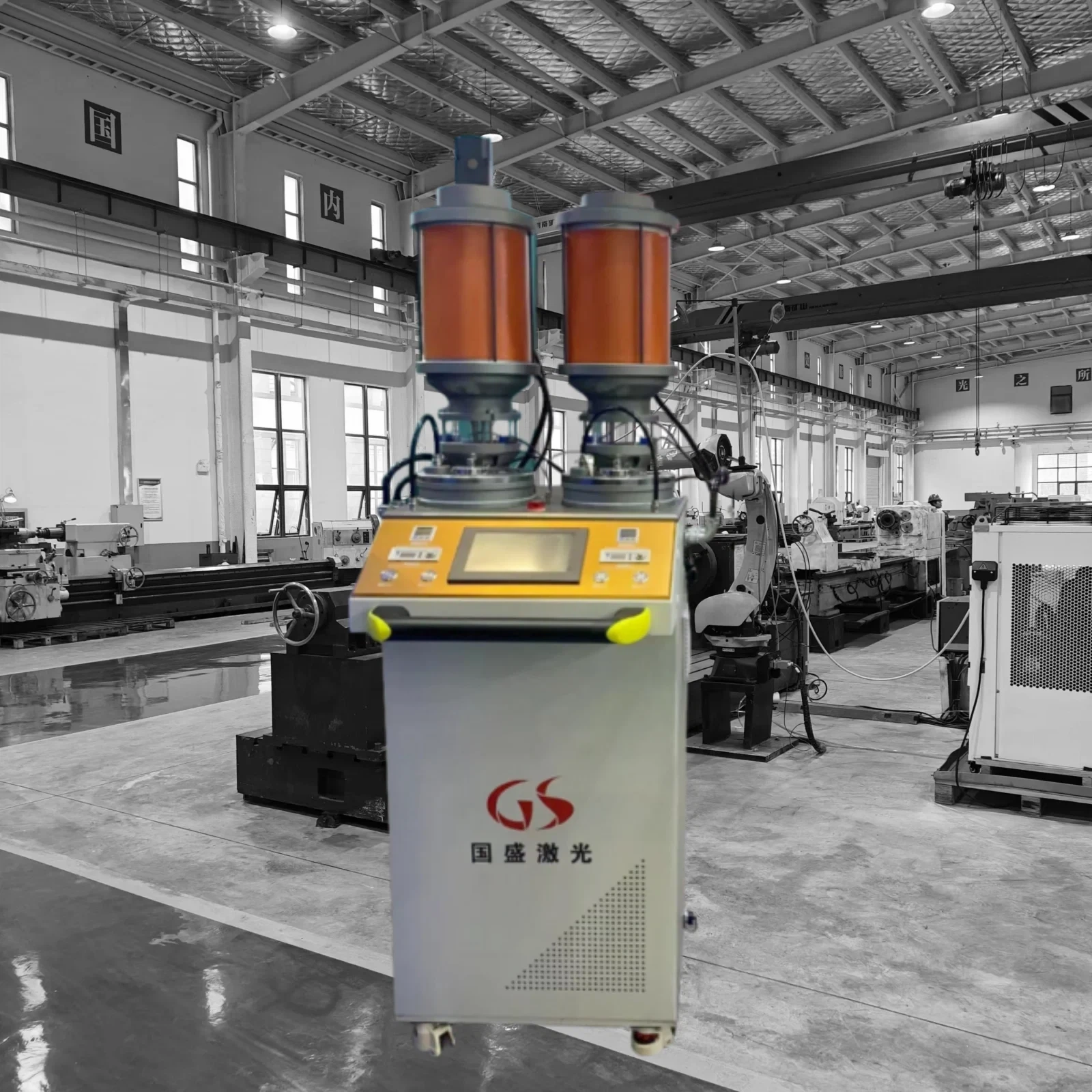
Powder Feeder

Laser Hardening Head
Challenges and Future Trends
The development of laser remanufacturing technology faces four main challenges: a limited variety of dedicated materials and a lack of high-performance repair materials; reliance on imports for core equipment and components; insufficient industry recognition; and an incomplete standard system. In the future, the technology will develop towards intelligence and automation. Artificial intelligence and machine learning will be used to optimize manufacturing parameters and achieve real-time quality control. On-site remanufacturing is another important trend, with laser equipment developing towards miniaturization and integration. By 2035, the development goal for China's laser remanufacturing industry is the maturation of intelligent technology and an industrial scale reaching 50 billion yuan. In the long term, laser remanufacturing will support distributed service systems, achieve widespread application in high-end equipment manufacturing, and provide core technical support for the circular economy.