

Leading the Green Innovation in Industrial Cleaning
In the field of industrial cleaning, traditional processes such as pickling and sandblasting are gradually being eliminated by the market due to drawbacks like severe pollution and substrate damage. As a new type of green cleaning technology, laser cleaning, with core advantages of non-destruction, high efficiency and environmental friendliness, is rapidly replacing traditional processes and has been widely applied in various fields including industrial manufacturing, cultural relic restoration and aerospace. This article will deeply analyze the technical core, core advantages, application scenarios and industrial value of laser cleaning, helping industry practitioners fully understand this innovative technology.

Technical Core: The Energy Conversion Logic of Laser Cleaning
The core principle of laser cleaning is based on the precise absorption and rapid conversion of energy. When the laser beam irradiates the surface of an object, the dirt layer will first absorb the laser energy and quickly convert it into thermal energy, completing heating, melting and even vaporization in microseconds to separate from the substrate surface. Different from traditional cleaning that relies on physical grinding or chemical dissolution, laser energy can penetrate into the tiny gaps on the object surface, without being limited by the shape and size of the object, thus achieving all-round and dead-angle-free cleaning. This technical logic not only ensures cleaning efficiency, but also avoids damage to the substrate from the source, laying the foundation for its application in the field of precision cleaning.
Core Advantages: Dual Breakthroughs in Environmental Friendliness and Non-Destructive Cleaning
Compared with traditional industrial cleaning processes, the core advantages of laser cleaning are concentrated in two dimensions: environmental friendliness and non-damage to substrates. It does not require the use of chemical solutions such as pickling and phosphating, eliminating chemical pollution from the source; the waste generated from cleaning is solid powder with small volume and easy collection and treatment, which is an innovative technical solution to replace traditional polluting cleaning processes. At the same time, laser cleaning achieves non-contact and non-grinding operations through precise threshold calculation and parameter setting, with no obvious thermal effect and no damage to the substrate. It is suitable for cleaning thin sheet materials below 30mm, as well as precision/fragile items such as molds and cultural relics, solving the core pain points of traditional processes.


Scenario Adaptability: Full-Range Coverage from Precision Components to Large-Scale Equipment
Laser cleaning has extremely strong scenario adaptability and can cover the full-dimensional cleaning needs from precision components to large-scale equipment. In the precision field, it can remove micron-level pollution particles and adapt to the pre-welding and post-welding cleaning of precision instruments and micro-components; pulsed laser can specifically meet the needs of industrial scenarios such as titanium alloy oxide scale removal and stainless steel weld seam/weld spot cleaning. In the field of large-scale equipment, ultraviolet laser is suitable for cleaning large components. Combined with optical fiber transmission and robot collaboration, it can realize automatic cleaning of long-distance and hard-to-reach parts such as ships, aircraft and weapons and equipment, greatly expanding the application boundary of industrial cleaning.
Industrial Value: Operational Advantages of Low Cost and High Flexibility
The industrial value of laser cleaning is reflected in two core points: low-cost operation and high flexible adaptability. The equipment operates stably for a long time without consumables, only consumes a small amount of electricity, and the maintenance cost is much lower than that of traditional processes; at the same time, it can seamlessly connect with automatic production lines to improve operation efficiency. In addition, by adjusting parameters such as laser power and frequency, the same equipment can realize the dual functions of cleaning and surface roughening, accurately control the operation range and intensity, and balance efficiency and cost. This "multi-functional in one machine, energy-saving and low-carbon" feature is in line with the core needs of modern industry for cost reduction, efficiency improvement and green development, promoting the acceleration of its industrialization.

Laser equipment components

Fiber Laser Machine

Laser Cladding Head
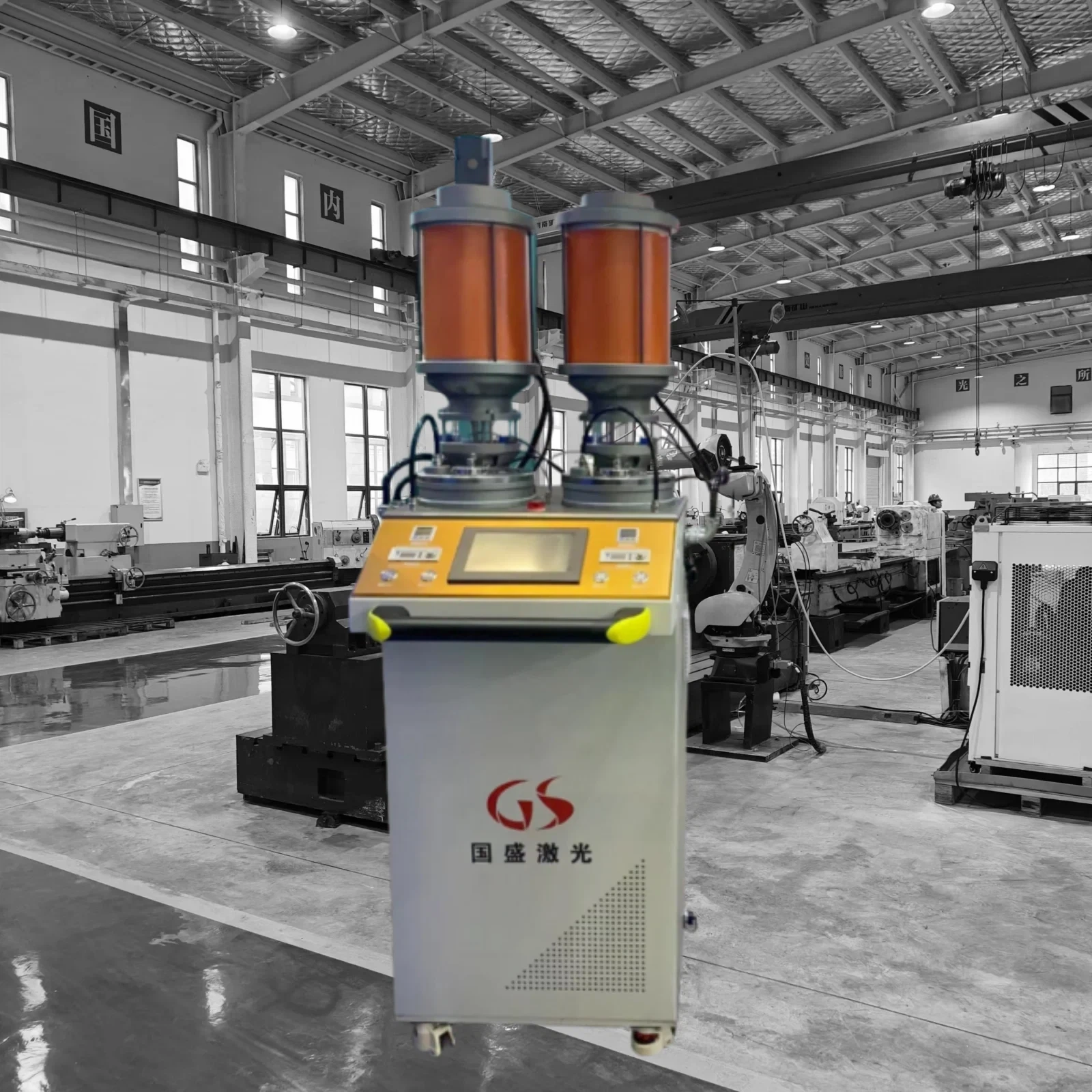
Powder Feeder

Laser Hardening Head
Laser Cleaning Ushers in a New Era of Industrial Cleaning
With precise energy conversion as the core, laser cleaning has completely innovated the technical logic and application mode of traditional industrial cleaning by virtue of advantages such as environmental friendliness, non-destructive cleaning, wide scenarios and controllable cost. From precision components to large-scale equipment, from industrial manufacturing to cultural relic restoration, its application scenarios continue to expand and its industrial value is increasingly prominent. With the continuous iteration of technology and cost optimization, laser cleaning will surely become the mainstream solution for industrial cleaning in the future, leading the industry to transform in a green, efficient and precise direction, and injecting new momentum into the high-quality development of the manufacturing industry.