

On November 27, 2018, the Guantang Bridge in Liuzhou, Guangxi was officially opened to traffic, and the Hong Kong-Zhuhai-Macao Bridge was officially opened to traffic on October 24. These Bridges embody China's top bridge construction technology, showing the world the good side of China's reform and opening up. The word "bridge" is defined in the Xinhua Dictionary as a structure erected over rivers, lakes and seas to enable vehicles and pedestrians to pass smoothly. And in their body or large or small have the shadow of laser process application, since the advent of laser technology has been rapid development, from a single industry application spread to all walks of life, become an indispensable part of the development of some industries. The application of the bridge industry is a symbol of the gradual maturity of laser process.
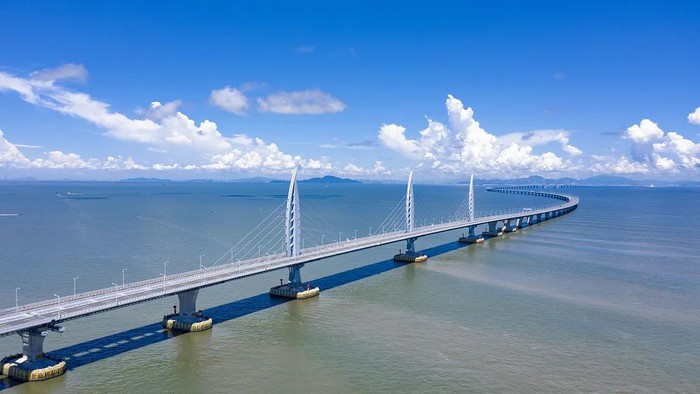
Bridges are generally composed of five major components and five small components, the five major components mainly include (1) bridge span structure (or bridge hole structure/superstructure), (2) bridge support system, (3) pier, abutment, (4) cap, (5) digging well or pile foundation. The five small parts mainly include (1) bridge deck paving, (2) anti-drainage system, (3) railing, (4) expansion joint, (5) lighting. In which parts does the laser process reflect its wisdom?

Application of laser cutting in bridge construction
Laser cutting is the use of high power density laser beam to irradiate the cut material, so that the material is quickly heated to the vaporization temperature, evaporation to form holes. With the movement of the beam on the material, the hole continuously forms a very narrow width (such as about 0.1mm) slit to complete the cutting of the material.
Modern bridge construction will be applied to a large number of metal materials applied to the construction of Bridges, in order to reduce the load bearing of the bridge itself to extend the life and its safety. Therefore, the texture and thickness of the metal have greater requirements, fiber laser cutting machine can cut carbon steel, stainless steel, aluminum alloy, copper and other metals, and through the laser cutting material, good slit quality, vertical section, no burrs, thin oxide layer, smooth section, small thermal deformation, high curve cutting accuracy. These advantages can not only speed up the process of construction, but also ensure the quality of materials applied to bridge span structures, bridge support systems and other materials.
In addition, there are fiber laser pipe cutting machine, the equipment is mainly cutting pipe, square pipe, circular pipe, shaped pipe, etc., the material cutting diameter and thickness can meet the needs of large Bridges, such as the cutting of railings, street lamp piles can be cut using the pipe cutting machine, with multiple pipe simultaneously cutting, flexible processing and other significant advantages.
Application of laser welding in bridge construction
Laser welding is the use of high-energy laser pulse to the material in a small area of local heating, laser radiation energy through the heat conduction to the internal diffusion of the material, the material after melting to form a specific molten pool to achieve the purpose of welding. Laser welding process is widely used in manufacturing, powder metallurgy, automotive industry, electronics industry, biomedical and other industries. It can realize spot welding, butt welding, overlap welding, sealing welding, etc., depth to width ratio of high, small weld width. It has the following advantages: small heat affected zone, small deformation, fast welding speed, smooth weld, beautiful, no processing after welding or only simple processing, high quality weld, no porosity, accurate control, small focusing spot, high positioning accuracy, easy to achieve automation.
A large number of thick steel plates and metal material parts are used in the bridge construction industry. Laser welding can weld two steel plates with a thickness of 10mm, or even thicker steel plates, and can ensure that the weld is tight, slag free and smooth. The use of laser brazing and other forms of parts welding, which is the use of liquid filler metal in the base material surface wetting, spreading and base material mutual dissolution and diffusion, as well as in the base material gap wetting, capillary flow, caulking and base material mutual dissolution and diffusion to achieve the connection between the parts. It can not only meet the technical requirements but also effectively increase toughness.
Application of laser cladding in bridge construction
Laser cladding is a new surface modification technology. The coating layer is formed on the surface of the substrate by adding cladding material on the surface of the substrate and using a high energy density laser beam to melt and coagulate with the thin layer of the substrate surface.
The metal used in bridge construction should be exposed to the outdoors to withstand the wind and rain, so if the metal laser cladding can significantly improve the wear resistance, corrosion resistance, heat resistance, oxidation resistance and electrical characteristics of the base surface, so as to achieve the purpose of surface modification or repair, which not only meets the requirements of the specific performance of the material surface, but also saves a lot of valuable elements.
Application of laser hardening in bridge construction
Laser hardening is the use of laser to heat the surface of the material above the phase change point, as the material itself cools, austenite into martensite, so that the surface of the material hardening technology. The hardness of the metal after laser quenching is increased, the microstructure of the quenching layer is fine, and the strength and toughness are good. Laser hardening technology can strengthen the surface of all kinds of guide rails, large gears, journal, cylinder inner wall, mold, shock absorber, friction wheel, roll, roller parts, some of the bridge construction in the shock absorber, road guide rail, roller parts, etc., the metal material after treatment of this technology.
Application of laser cleaning in bridge construction
Laser cleaning is a photophysical reaction caused by the interaction between high intensity beam, short pulse laser and pollution layer, so as to achieve the purpose of cleaning. After the metal materials in the bridge construction are used for a period of time, some materials will rust or show that the layer has fallen off, and they must be "cleaned" before repair to carry out a new round of repair. Now the cleaning agents that pollute the environment have been stopped, and the dye laser cleaning has non-abrasive, non-contact, non-thermal effect and is suitable for various materials and other cleaning characteristics, which is considered to be the most reliable and effective solution. At the same time, laser cleaning can solve problems that cannot be solved by traditional cleaning methods.
Although China's high-speed rail technology is the world's leading position, many remote mountainous areas cannot be reached by high-speed rail, so it is necessary to build a large number of roads and Bridges, so that remote places can connect with the outside world, so that things can go out there, and realize everyone's prosperity. As the laser technology applied to bridge construction can be expected in the future, it will also become one of the growth points of laser equipment application industry.