


I. Lower Equipment Investment: A Cost-Effective Alternative to Coaxial Wire Feeding
One of the most prominent advantages of Laser side wire feeding Cladding lies in its lower equipment investment compared to coaxial wire feeding cladding. Coaxial wire feeding systems require high-precision components such as coaxial nozzles, complex beam shaping assemblies, and sophisticated coaxial positioning control systems to achieve precise coaxial coupling between the wire and the laser beam, resulting in a high initial investment threshold. In contrast, side wire feeding cladding systems have a simpler structure, eliminating the need for complex coaxial coupling mechanisms. They only need a conventional wire feeding mechanism to deliver the wire to the laser action area at a certain angle, significantly reducing the cost of core components. Typically, the investment cost of a side wire feeding system is only 50%-70% of that of a coaxial system, making it a more cost-effective choice for small and medium-sized enterprises (SMEs) and maintenance workshops sensitive to costs..
Ⅱ.Superior Adaptability to Large-Diameter Wires and Operational Flexibility
Another key advantage of laser side wire feeding cladding is its excellent adaptability to large-diameter wires and convenient operation and debugging, which are critical differences from coaxial wire feeding cladding. Coaxial systems are limited by the channel size of the coaxial nozzle and the focusing range of the laser beam, making them suitable mainly for thin wires with a diameter of 0.8-1.2mm. Using large-diameter wires (1.6mm or more) in coaxial systems often leads to issues such as wire-nozzle interference and insufficient laser energy coupling. Side wire feeding cladding, however, breaks through this limitation through an off-axis wire feeding angle design, stably accommodating large-diameter wires of 1.2-3.0mm. Additionally, side wire feeding cladding is easier to operate and debug: its core adjustment involves the wire feeding angle, distance, and relative position to the laser action point, with a wider parameter matching range. This reduces the skill requirements for operators, lowers training costs, and improves the stability of Laser Cladding operations, unlike the complex and time-consuming coaxial system calibration that demands high professional skills.


Ⅲ.Market Prospects Driven by Mid-to-Low-End Market Penetration
Driven by its cost-effectiveness and ease of operation, laser side wire feeding cladding is poised for increased penetration in the mid-to-low-end market. With the advancement of manufacturing transformation and upgrading, SMEs have a growing demand for surface strengthening and repair technologies. However, due to limited capital and technical strength, their acceptance of high-cost coaxial wire feeding systems is low. The low-cost and easy-to-operate characteristics of side wire feeding Laser Cladding precisely match the needs of the mid-to-low-end market. In the future, it will gradually replace traditional technologies such as surfacing welding and thermal spraying, continuously boosting its penetration rate in the mid-to-low-end market and promoting the large-scale application of laser cladding technology.
Ⅳ.Growth Drivers from Heavy Equipment Repair and Future Expansion
The growth of laser side wire feeding cladding is also strongly driven by the huge demand for heavy equipment repair, with broad future market prospects. As a major manufacturing country, China has a large stock of heavy equipment, and parts wear and corrosion problems are prominent in fields such as engineering machinery, metallurgical equipment, and petrochemical equipment, leading to strong repair demand. The characteristics of side wire feeding cladding-adaptability to large-diameter wires, high Laser Cladding efficiency, and low repair costs-perfectly match the core needs of heavy equipment repair. Moreover, with the continuous iteration of laser and wire feeding control technologies, the technical gaps between side wire feeding and coaxial wire feeding cladding (such as coating forming precision) are gradually narrowing. This will further expand its application scenarios, enabling it to penetrate some mid-to-high-end manufacturing fields and open up broader market space.
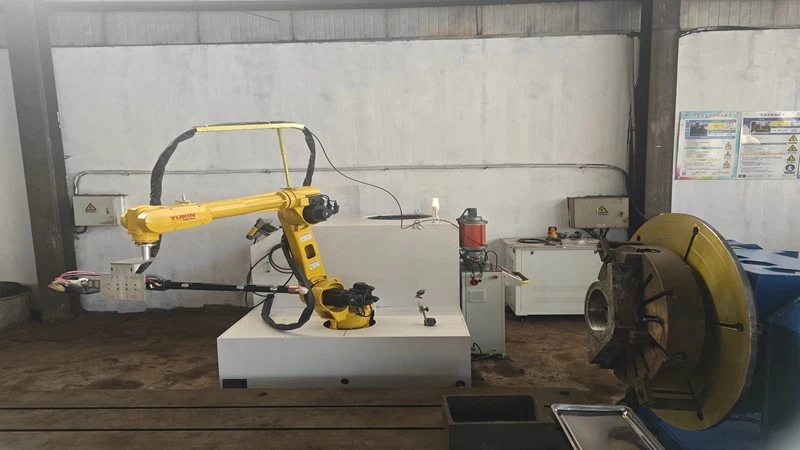
Core Components Of Laser Cladding System

 Fiber Laser Machine
