

Guidelines for Quality Control of Laser Cladding Layers: 5 Core Issues and Efficient Solutions
As a key process for the repair and surface strengthening of high-end equipment components, laser cladding technology has its cladding layer quality directly determining the service life and operational safety of products. Factors such as material performance, laser beam quality, and process parameters all affect the cladding effect. In practical applications, common problems such as cracks, distortion, and oxidation are often encountered. This article focuses on the core quality pain points of laser cladding layers, analyzes their causes and targeted solutions, and provides practical references for technical personnel in the industry.

Crack Issue: Dual Approaches of Stress Regulation and Material Optimization
The rapid heating and cooling of laser cladding easily create a significant temperature gradient between the cladding layer and the substrate, generating tensile stress that causes cracks-most commonly in the interface substrate, as well as in the fusion layer and overlapping areas. Addressing this requires a dual focus on stress control and material improvement: preheating the substrate and implementing subsequent slow cooling reduce the temperature gradient and mitigate thermal stress. Increasing Ni content in the Fe-Cr-Ni-B-Si system, enhancing energy density, or applying electromagnetic stirring can lower cracking sensitivity. Additionally, controlling coating thickness and adopting composite coating technology (with an intermediate transition layer) enables continuous transitions in composition and performance, weakening internal stress while improving bonding strength, effectively suppressing crack formation.
Substrate Distortion: Multi-Dimensional Process Protection Strategies
Substrate distortion directly impairs equipment assembly accuracy, so systematic process design is essential for prevention. Key measures start with preprocessing: heat treating the substrate to eliminate inherent internal stress lays a stable foundation. Prioritizing thinner coatings minimizes the impact of heat input on the substrate, reducing the driving force for distortion. Combining preheating with post-treatment balances volume shrinkage from temperature changes, further stabilizing the substrate structure. Supplementary methods such as pre-stress tensioning, pre-deformation, or mechanical clamping restrict the substrate's deformation space during cladding, ensuring structural stability and avoiding deviations that affect subsequent assembly.


Oxidation and Burning Loss, and Surface Roughness: Environmental Control and Molten Pool Optimization
High-energy lasers easily cause oxidation and burning loss of alloying elements, while the molten pool's surface tension gradient leads to wrinkling after solidification, increasing surface roughness. For oxidation protection, gas shielding is the mainstream solution: helium offers the best results, delivering a smooth surface, fine microstructure, and high hardness, though it comes with higher costs. Argon is the industrial preferred choice due to its excellent cost-effectiveness, with careful control of gas fluidity being critical. To reduce surface roughness, optimizing the molten pool state is key-adjusting laser beam parameters and regulating the molten pool's temperature field weakens the impact of radial surface tension gradients, minimizing wrinkling and achieving a smoother cladding surface.
Dilution Rate Control: Parameter Balance and Performance Guarantee
The dilution rate is a critical indicator of cladding layer performance, with an ideal range of within 5% to balance surface performance and bonding strength. Its control hinges on parameter coordination: the powder feeding speed and scanning speed interact dynamically-at low powder feeding speeds, the dilution rate decreases as scanning speed increases, while the opposite occurs at high feeding speeds due to the powder's thermal shielding effect. Using a rectangular laser beam effectively reduces the dilution rate, but excessively low rates must be avoided: insufficient melting of the substrate leads to poor bonding strength, risking cladding layer detachment and failure. Precise adjustment of these parameters ensures the dilution rate stays within the optimal range, safeguarding the cladding layer's overall performance.

Laser equipment components

Fiber Laser Machine

Laser Cladding Head
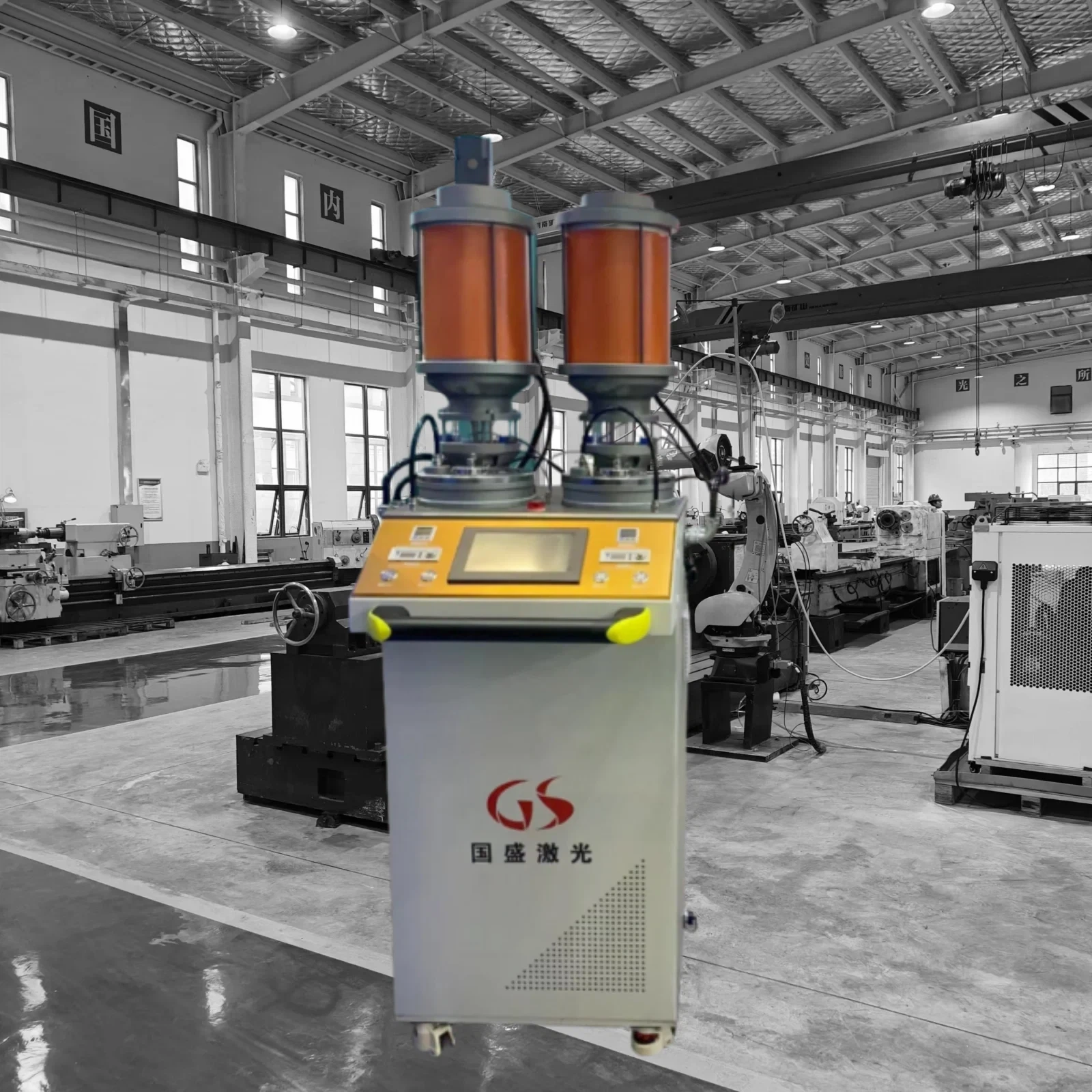
Powder Feeder

Laser Hardening Head
Core Logic of Laser Cladding Quality Control and Technical Support
The core of laser cladding layer quality control is to accurately identify the causes of problems and balance performance and cost through targeted measures such as material improvement, process parameter optimization, and environmental control. From stress regulation for cracks and distortion, to environmental and molten pool optimization for oxidation and roughness, and then to parameter balance for dilution rate, a full-process control mindset needs to be established.