

Laser Cladding Technology: Addressing Agricultural Machinery Repair Pain Points and Empowering Agricultural Modernization
Against the backdrop of rapid development in agricultural mechanization, agricultural machinery parts are constantly subjected to wear, corrosion, impact, and other issues caused by complex soil environments and high-load operations. Traditional repair technologies such as heat treatment and chromium plating have gradually struggled to meet the core requirements of agricultural machinery for wear resistance, corrosion resistance, and pollution-free performance, thereby restricting the improvement of agricultural production efficiency. With its advantages of excellent cladding layer performance, high repair precision, and significant strengthening effects, laser cladding technology has become a key solution for agricultural machinery repair and performance upgrading. It not only breaks through the bottlenecks of traditional technologies but also promotes the upgrading of agricultural machinery manufacturing towards high-endization, injecting strong momentum into agricultural modernization.

In-situ Repair: Precisely Restoring Core Functions of Agricultural Machinery Parts
Agricultural machinery is prone to plastic deformation, wear, cracks, and other failures under harsh working conditions. Traditional repair methods often suffer from problems such as large deformation and low precision. Laser cladding technology adopts an in-situ repair mode, which can accurately fill defective areas and restore the original dimensions and geometric tolerances of parts without extensive disassembly, leveraging its characteristics of rapid cooling and low heat input. For high-frequency damaged parts such as gears and shafts, laser cladding repair not only ensures normal operation but also enhances impact resistance and wear resistance. For example, repaired gears can withstand alternating stress impacts, while shaft parts can effectively solve the vicious cycle caused by abrasive wear from sand particles, significantly reducing agricultural machinery maintenance costs and downtime.
Wear Resistance Enhancement: Adapting to Abrasive Wear Scenarios in Complex Soils
Wear of agricultural machinery is mainly divided into adhesive wear and abrasive wear, with abrasive wear being the most common-parts in contact with soil and sand during tillage are prone to severe wear. Laser cladding technology constructs high-performance wear-resistant coatings by selecting suitable cladding materials and optimizing processes, fundamentally improving the wear resistance of parts. Among them, iron-based cladding materials are the preferred choice in the agricultural machinery field due to their controllable cost and strong adaptability to working conditions. They can effectively resist abrasive wear on tillage parts such as plowshares and rotary blades, extending the service life of parts. In recent years, hard phase particle reinforcement technology (e.g., WC, TiC) has further expanded the application boundaries of laser cladding in high-wear working conditions.


Corrosion Resistance Upgrade: Withstanding Erosion in Harsh Chemical Environments
Tillage parts of agricultural machinery are often exposed to corrosive substances such as pesticides, chemical fertilizers, and organic fertilizers, coupled with the impact of humid environments, which easily leads to rust and damage, shortening the service life of equipment. Laser cladding technology significantly improves the corrosion resistance of parts by optimizing cladding powder composition and external field process control. Nickel-based self-fluxing alloy powders, as mainstream anti-corrosion cladding materials, can form dense protective layers to effectively isolate the penetration of corrosive media, and are widely used in the repair and strengthening of parts such as fertilizer application pipes and seeders. Meanwhile, regulating external field conditions such as temperature and protective atmosphere during the cladding process can reduce pores and cracks in the cladding layer, further enhancing anti-corrosion effects.
Hardness Improvement: Coping with Impact Loads and Hard Object Damage
Stones and plant roots in the soil are likely to cause impact damage to tillage parts such as rotary tillers and disc harrows, imposing higher requirements on the hardness of agricultural machinery parts. Laser cladding technology achieves precise improvement of part hardness through material selection and process optimization: compared with Ni60 alloy, Fe60 alloy cladding layers have higher bonding zone hardness, uniform distribution, and good metallurgical bonding, making them more suitable for common agricultural machinery substrates such as 45 steel. By controlling laser power and scanning speed, rapid melting and solidification of the cladding layer can be achieved, forming non-equilibrium eutectic structures. Combined with Si atom solid solution strengthening and grain refinement strengthening effects, high-quality coatings with smoothness, density, and small heat-affected zones are constructed, enabling parts to maintain structural stability while resisting impact loads.

Laser equipment components

Fiber Laser Machine

Laser Cladding Head
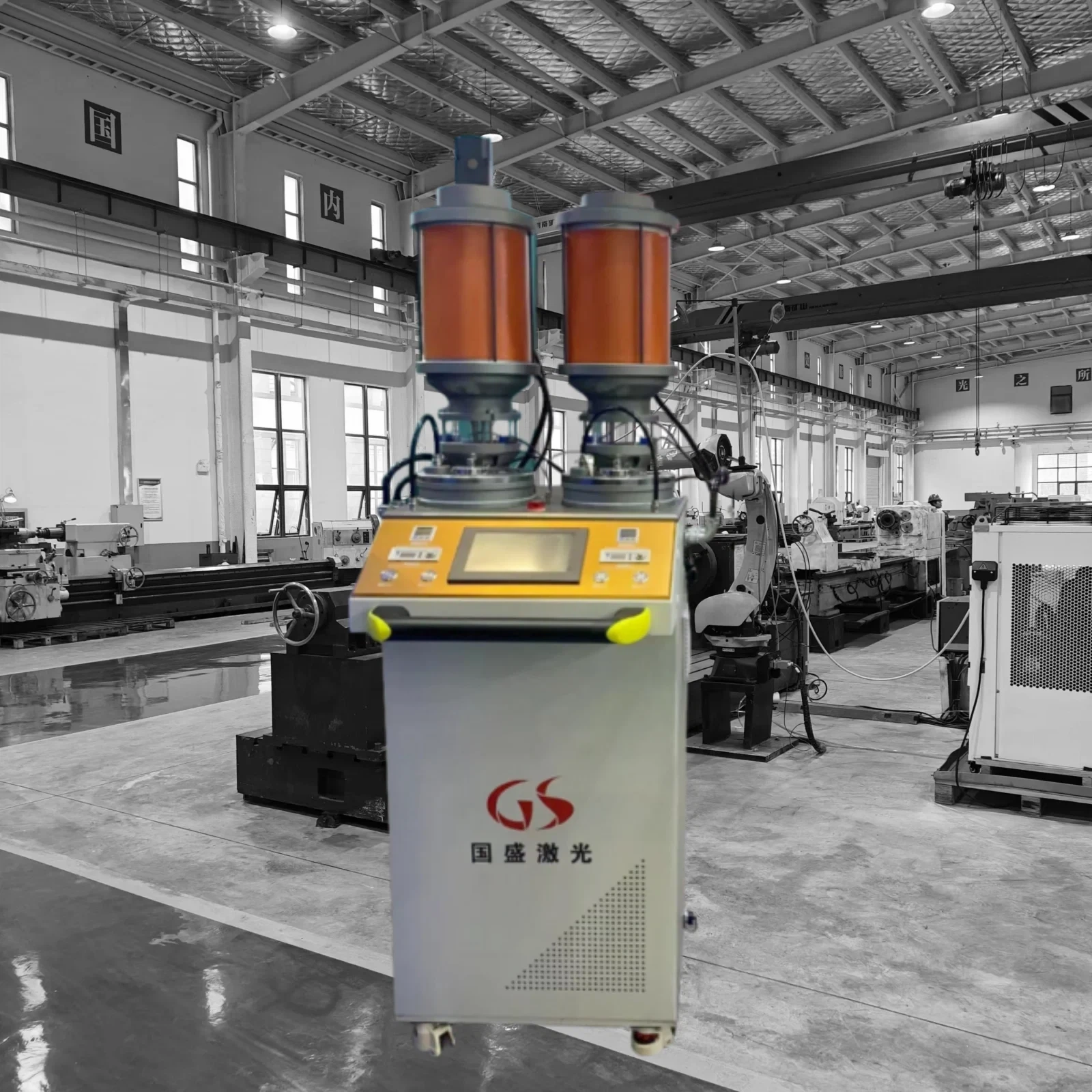
Powder Feeder

Laser Hardening Head
Technology Empowerment: Leading the High-Quality Development of Agricultural Machinery Manufacturing
With its four core capabilities-in-situ repair, wear resistance, corrosion resistance, and hardness strengthening-laser cladding technology comprehensively addresses the pain points of traditional agricultural machinery repair technologies, providing an integrated "repair + upgrade" solution for agricultural machinery parts. It not only reduces the use and maintenance costs of agricultural machinery but also promotes the transformation of agricultural machinery manufacturing from "passive repair" to "active strengthening," narrowing the technical gap with high-end fields such as industrial machinery and aerospace. With the continuous optimization of cladding materials and processes, laser cladding technology will achieve wider applications in agricultural machinery manufacturing and repair, providing solid technical support for the high-quality development of agricultural mechanization and the upgrading of agricultural modernization, and helping to comprehensively improve agricultural production efficiency and sustainability.