

Laser Hardening for Metalworking and Toolmaking: Precision-Driven Durability Solutions
In the high-stakes sectors of metalworking and toolmaking, component performance directly impacts production efficiency, cost control, and end-product quality. Traditional surface hardening techniques-including flame hardening, induction hardening, and carburizing-have long served as industry staples, but they are increasingly limited by critical drawbacks: excessive heat input leading to component distortion, imprecise targeting of hardening zones, and the need for costly post-processing. Laser hardening, a cutting-edge thermal processing technology, has emerged as a transformative alternative, redefining standards for precision and durability. By leveraging a focused, high-energy laser beam to selectively heat and rapidly quench metal surfaces, this process delivers superior hardness, minimal dimensional changes, and eco-friendly operation. This article explores the core mechanics, key advantages, practical applications, technological advancements, and strategic value of laser hardening, highlighting its pivotal role in modern metalworking and toolmaking.

Core Mechanics of Laser Hardening
Laser hardening operates on the fundamental principle of austenitization followed by rapid self-quenching, a process that transforms the surface microstructure of metals to enhance hardness. A high-power laser-typically fiber, CO₂, or diode-based-is directed at the target metal surface (commonly steel, cast iron, or alloyed metals), heating it to 800–1000°C, a temperature above the austenitization threshold but without deep penetration into the substrate. Unlike traditional methods that rely on external coolants, laser hardening utilizes the cold core of the component to conduct heat away from the heated surface, achieving cooling rates of up to 1000°C/s. This rapid quenching transforms the surface layer into martensite, a dense, hard crystalline structure that boosts hardness to 58–65 HRC-significantly higher than the base material.
Key Advantages Over Traditional Hardening Methods
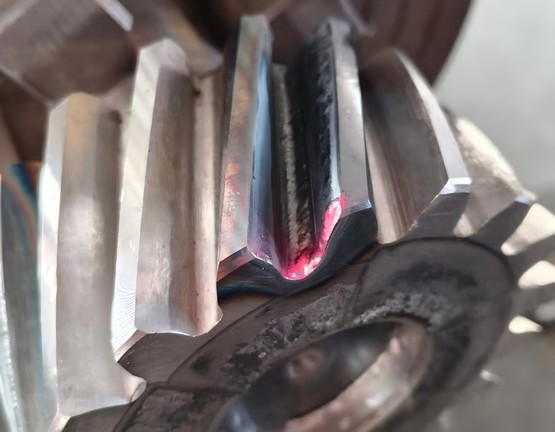
Laser hardening offers a suite of advantages that address the limitations of traditional techniques, making it a preferred choice for modern manufacturers. First, its unparalleled precision allows for targeted hardening of complex geometries-such as gear teeth, tool edges, and mold cavities-with minimal impact on surrounding areas, eliminating the need for masking or post-processing. Second, low heat input results in minimal component distortion (typically <0.01 mm), reducing scrap rates by 30–40% and cutting costs associated with rework. Third, the martensitic surface layer enhances wear resistance by 2–3x and extends tool and component life by 50–150% in high-load, high-abrasion applications. Fourth, the process is eco-friendly: no chemicals, coolants, or lubricants are required, reducing energy consumption by 20–30% compared to induction or flame hardening and aligning with sustainable manufacturing goals. Finally, its high processing speed and compatibility with CNC integration enable automation, improving production efficiency and ensuring consistent quality across large batches.

Technological Advancements and Strategic Value
Recent technological advancements have further elevated the capabilities of laser hardening, expanding its strategic value for manufacturers. Integration with artificial intelligence (AI) and machine learning enables real-time monitoring and adjustment of process parameters, optimizing hardening results and reducing human error. The development of ultrafast lasers and high-power diode lasers has improved processing speed and flexibility, allowing for faster cycle times and treatment of larger or more complex components. Alignment with Industry 4.0 initiatives-such as IoT connectivity and data analytics-facilitates predictive maintenance of equipment and components, minimizing downtime and operational costs.
Laser hardening has emerged as a transformative technology that addresses the critical pain points of traditional surface hardening in metalworking and toolmaking. Its precision, minimal distortion, enhanced durability, and eco-friendly operation make it an indispensable solution for modern manufacturers seeking to improve efficiency, reduce costs, and deliver high-quality products. From cutting tools and molds to aerospace components and custom parts, its versatility spans diverse applications, while ongoing technological advancements-including AI integration and Industry 4.0 alignment-continue to expand its potential. For businesses looking to gain a competitive edge in a rapidly evolving industry, investing in laser hardening is a strategic decision that drives long-term value. As the demand for precision and sustainability grows, laser hardening will remain at the forefront of innovation, shaping the future of metalworking and toolmaking with its unmatched performance and adaptability.
