

An Efficient Innovative Solution for Metal Surface Hardening
In industrial fields such as machinery manufacturing, metallurgy, and aerospace, the surface hardness and wear resistance of metal parts directly determine equipment service life and operational safety. Laser quenching (also known as pulsed laser quenching), as a "laser surface hardening" technology emerging in the 1960s, breaks through the limitations of traditional quenching processes with its high-power density energy input and rapid self-cooling hardening mechanism, becoming the core preferred solution for current metal surface hardening. This article will analyze the industrial value and practical scenarios of laser quenching technology from four core dimensions: technical principle, key advantages, industrial applications, and equipment solutions, providing technical references for relevant enterprises.

Technical Principle: Rapid Thermal-Cold Cycle Driven by High-Power Laser
The core logic of laser quenching is an efficient cycle of "instantaneous heating - self-cooling hardening," whose principle combines scientificity and practicality. The technology uses high-power density, high-brightness laser radiation generated by pulsed lasers to focus on the surface of metal workpieces. The surface layer absorbs energy in an extremely short time, causing the temperature to soar above 1000℃ (transformation temperature), rapidly completing austenitization. Without external cooling media such as water or oil, after the laser irradiation stops, the high-temperature surface layer conducts heat quickly through the workpiece matrix, and the temperature drops sharply below 500-700℃ (critical quenching temperature). Austenite transforms into martensite, realizing surface hardening. The entire process has a small heat-affected zone, only changing the microstructure and properties of the workpiece surface within the range of 0.1-2.0mm, ensuring the original toughness of the matrix.
Five Key Features Leading Traditional Processes
Compared with traditional technologies such as induction quenching and carburizing quenching, the advantages of laser quenching are concentrated in core dimensions such as efficiency, flexibility, and environmental protection. It has higher energy density, faster heating and cooling speeds, eliminating additional cooling steps and significantly improving processing efficiency. With fast and concentrated heating, the workpiece deformation is extremely small, and the heating layer depth and trajectory can be precisely controlled to adapt to complex part processing. Without the need for special induction coils or being limited by furnace size, the processing of large parts and special-shaped parts is more convenient, and it is easy to integrate into automated systems, reducing labor costs. There is no pollutant emission throughout the process, meeting the requirements of environmentally friendly production. At the same time, it has outstanding local hardening capabilities, which can accurately focus on key working surfaces, avoiding performance waste caused by overall processing, and its comprehensive cost-effectiveness is far superior to traditional processes.


Life-Extending Solutions for Key Parts in Multiple Fields
Laser quenching technology is widely used in steel processing, covering multiple core industries such as machinery manufacturing, metallurgy, petroleum and petrochemical, and aerospace, becoming a core technology for improving the service life of key parts. For 75CrMo rolls in the metallurgical industry, after quenching, the hardened layer depth reaches 2mm, the hardness increases from HS40 to HS85, and the service life is extended by 6 times. The quenching depth of large valve seats is 1-3mm, and the wear resistance of the sealing surface is significantly improved. Through precise quenching of 3D curved surfaces, the depth (0.2-0.8mm) and hardness (HV400-490) of the hardened layer of steam turbine blades are controllable, adapting to high-temperature and high-pressure working conditions. In addition, after laser quenching, the service life of corrugating rolls, gears, molds, shafts and other parts is generally increased by more than 3-5 times, and the hardness is 2-3 HRC higher than that of traditional quenching, effectively reducing equipment maintenance and replacement costs.
Technical Support for Customized Flexible Processing
Professional laser quenching equipment is the core prerequisite for ensuring process effects, and the customized solutions launched by Guosheng Laser are highly representative in the industry. The equipment adopts advanced pulsed lasers, high-end industrial robots and high-precision control systems to form a multi-axis linkage flexible processing system, which can customize special models according to part shapes and process requirements. For complex scenarios, the developed 8-axis quenching equipment can accurately adapt to the processing of 3D curved parts, while the mobile laser quenching equipment solves the processing and repair problems of large, immovable workpieces. All equipment and processes have passed the ISO quality management system certification, combined with scientific testing methods to monitor the depth of the hardened layer and hardness uniformity throughout the process, providing stable and reliable processing guarantees for various products such as rolls, shafts, gears, molds, and valves.

Laser equipment components

Fiber Laser Machine

Laser Cladding Head
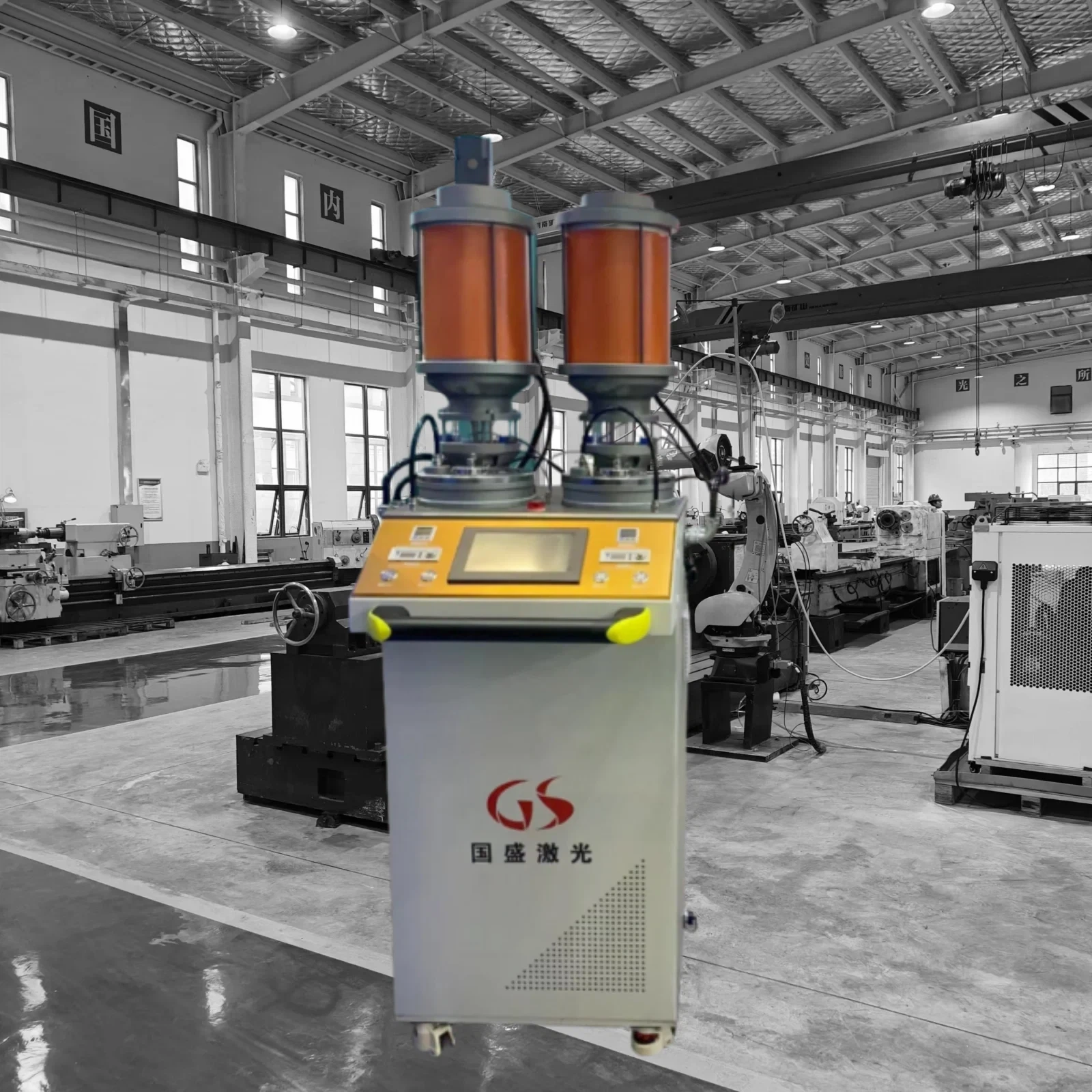
Powder Feeder

Laser Hardening Head
Laser Quenching Leads the Upgrade of Industrial Hardening Technology
With its unique principles, outstanding advantages, wide application scenarios and professional equipment support, laser quenching technology has become a benchmark technology for metal surface hardening in modern industry. It not only solves the pain points of traditional quenching processes such as large deformation, heavy pollution and poor adaptability, but also provides life-extending solutions for key parts in various industries through precise control and energy-saving characteristics. With the continuous upgrading of automation technology and laser performance, laser quenching will further expand its application boundaries in precision manufacturing, high-end equipment and other fields, helping enterprises reduce costs and increase efficiency, enhance core competitiveness, and promote the development of industrial surface hardening technology towards a higher quality stage.