

Technological Iteration of Gear Surface Hardening and the Rise of Laser Quenching
In the mechanical manufacturing industry, gears serve as core components for power transmission, and their load-bearing capacity and wear resistance directly determine the reliability and service life of equipment. Traditional gear surface hardening processes (such as carburizing, nitriding, induction hardening, etc.) have long faced two key pain points: significant deformation after heat treatment and uneven distribution of the hardened layer along the tooth profile, leading to reduced gear precision and shortened service life. With the development of laser technology, gear laser quenching has emerged as an ideal alternative to traditional processes, thanks to its core advantages of "precision heating, minimal deformation, and excellent performance," and is widely used in high-end equipment fields such as automotive, wind power, and machine tools. This article will comprehensively analyze the application value and industry prospects of gear laser quenching technology from dimensions including process principles, core advantages, cost value, and equipment support.

Precision Hardening Solution of Surface Pretreatment + Axial Tooth-by-Tooth Scanning
The efficiency and uniformity of gear laser quenching rely on a standardized process of "surface pretreatment + axial tooth-by-tooth scanning." The core goal of surface pretreatment is to improve the metal's absorption rate of laser light. The commonly used method is spray/brush painting, where a special laser-absorbing paint is applied to increase the absorption rate from less than 50% in the natural state to 85%-95%, avoiding energy waste. Axial tooth-by-tooth scanning is the key implementation step: a wide-band laser beam is formed by superimposing multiple laser beams, moving axially along the gear to scan one complete tooth surface at a time; after scanning, the gear rotates by one tooth pitch via a precision servo system, sequentially scanning all tooth surfaces one by one. This process can precisely control the hardened layer thickness (0.2-2mm) by adjusting the laser power (1-5kW) and scanning speed (5-30mm/s), ensuring uniform distribution of the hardened layer on the tooth top, tooth flank, and tooth root, and fundamentally solving the "weak point" problem of traditional processes.
Dual Breakthroughs in "Hard Tooth Surface & Soft Tooth Root" and High Wear Resistance & Fatigue Resistance
The most notable advantage of gear laser quenching is achieving gradient performance of "hard tooth surface and soft tooth root," perfectly balancing strength and toughness. Through localized rapid heating (temperature 850-950℃) and self-quenching cooling (cooling rate 10^4-10^5℃/s), the tooth surface forms an ultra-fine-grained martensitic structure with a hardness of HRC 58-62, which is 3-5 HRC higher than traditional carburizing and quenching; the tooth root does not undergo complete phase transformation, retaining pearlite/ferrite structure with a hardness controlled at HRC 30-40, significantly improving toughness and reducing the risk of fracture. Meanwhile, the residual compressive stress of 500-800MPa formed by rapid cooling increases gear wear resistance by 30%-50%, extends contact fatigue life by 2-3 times, and improves bending fatigue life by 1.5-2 times, fully adapting to harsh working conditions of heavy load and high speed. In addition, the tooth profile deformation after quenching is controlled within 0.01mm without cracks, enabling direct installation and use without subsequent grinding correction.


Cost Reduction and Efficiency Improvement Path by Shortening Cycles & Expanding Material Options
While improving performance, gear laser quenching brings significant cost advantages to enterprises. On one hand, process simplification greatly shortens the production cycle: it eliminates complex processes such as furnace loading, heat preservation, cooling, and grinding in traditional carburizing, requiring only two steps of "pretreatment - scanning quenching," reducing the production cycle by more than 50%; the laser energy utilization rate exceeds 80%, which is 40%-60% lower than that of traditional carburizing furnaces. On the other hand, the expanded range of material options realizes "high performance with low-cost steel": ordinary carbon steel (such as 45# steel) after laser quenching has a tooth surface hardness equivalent to that of alloy structural steel (20CrMnTi) after carburizing and quenching, reducing material costs by 30%-40%; at the same time, it can repair worn old gears through laser quenching, realizing the reuse of old parts and further reducing equipment maintenance costs. This dual value of "performance upgrading + cost reduction" makes it a core technical choice for enterprises to reduce costs and improve efficiency.
Integrated Solutions and Technical Guarantee from Guosheng Laser
The key to the implementation of gear laser quenching lies in professional equipment and customized process support. As an industry benchmark enterprise, Guosheng Laser provides a complete set of solutions. The company has established the Xi'an Aerospace R&D and Design Center and the Weinan Production Base. Its core products include 1-10kW special gear laser quenching machines, suitable for various types of gears such as spur gears, helical gears, and bevel gears with a modulus of 1-50, with a positioning accuracy of ±0.005mm to ensure scanning uniformity. The engineering team covers fields such as laser optics, material heat treatment, and automatic control, and can customize scanning paths and process parameters according to customer needs, as well as provide pre-sales sample testing, in-sales installation and commissioning, and 24/7 after-sales technical support. With strong R&D capabilities, fast delivery cycles (30-45 days), and cost-effective products, Guosheng Laser has become a core equipment supplier for enterprises in fields such as automotive gearboxes and wind power gearboxes.

Laser equipment components

Fiber Laser Machine

Laser Cladding Head
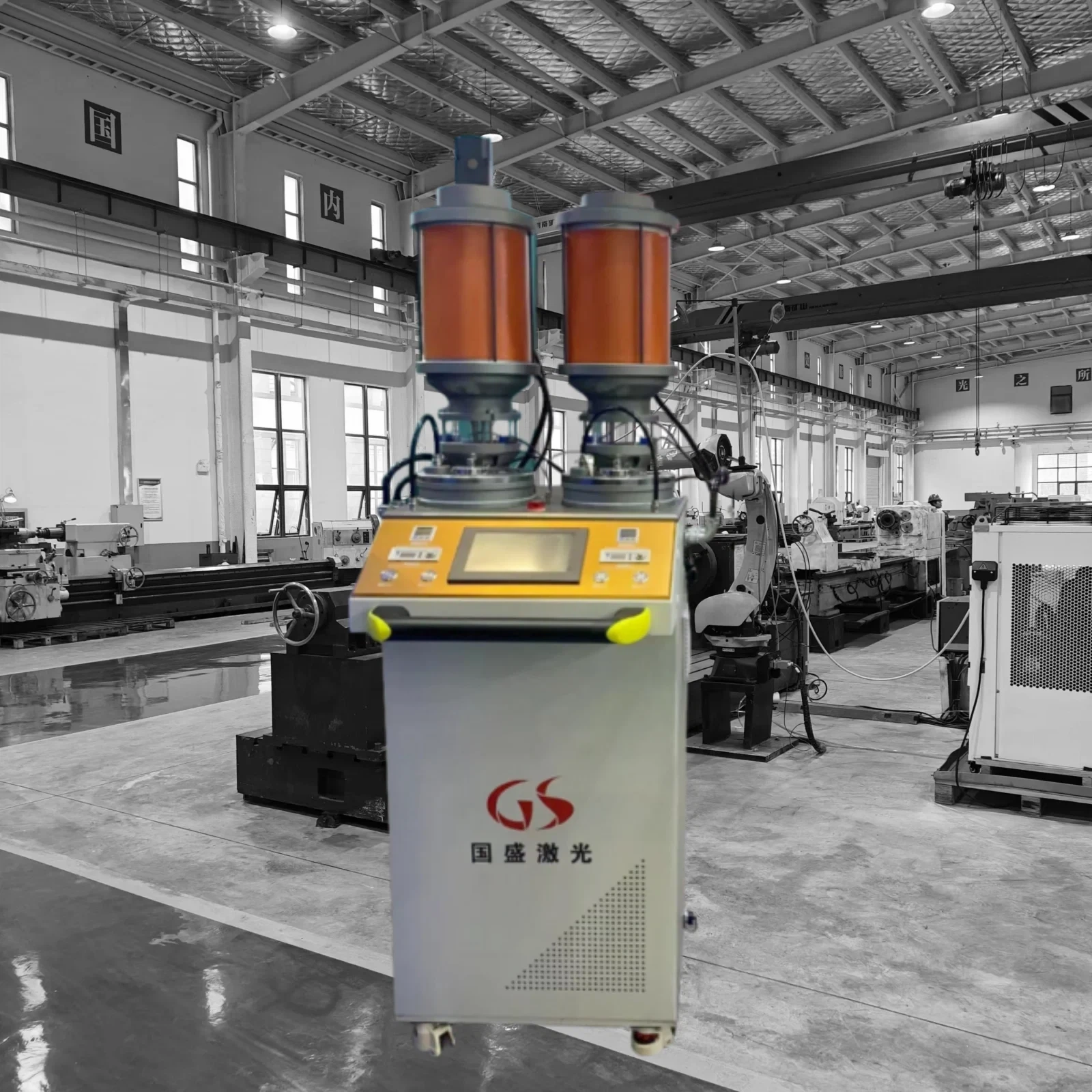
Powder Feeder

Laser Hardening Head
Laser Quenching Leads the Green and Efficient Upgrade of Gear Manufacturing
Gear laser quenching technology completely solves the pain points of traditional surface hardening processes such as large deformation and uneven hardened layers through precise controlled heating, achieving a triple breakthrough of "high performance, low cost, and environmental friendliness." Its unique performance of "hard tooth surface and soft tooth root," significant cost reduction and efficiency improvement advantages, and adaptability to low-cost steel are reconstructing the material selection and process design logic of gear manufacturing. With the development of high-power laser technology and AI-based process parameter optimization, laser quenching will further cover fields such as large gears (e.g., shield machine gears) and precision micro-gears (e.g., medical device gears) in the future. Meanwhile, driven by green manufacturing policies, it will replace high-energy-consumption and high-pollution traditional processes, becoming a core supporting technology for the high-end equipment manufacturing industry. For mechanical manufacturing enterprises, deploying gear laser quenching technology will be a key path to enhance product competitiveness, reduce costs, and improve efficiency.